

News & Politics
Shapiro administration announces wage theft protection for home health care workers
Pennsylvania Labor Secretary Nancy Walker announced the plan at SEIU Local 1201 in Philadelphia on Wednesday
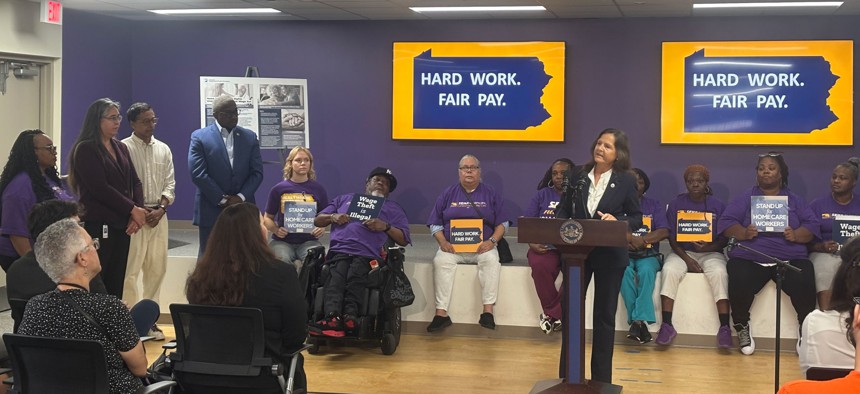
Pennsylvania Labor Secretary Nancy Walker announces a wage theft protection plan at SEIU Local 1201 in Philadelphia on Wednesday. Harrison Cann

Gov. Josh Shapiro’s administration wants to be more proactive in cracking down on wage theft – particularly in the home health care industry.
Labor and Industry Secretary Nancy Walker held a press conference in Philadelphia Wednesday to announce what officials called a “strategic labor law enforcement initiative” to protect home care workers from providers who break state wage laws.
The “Standing Up for Home Care Workers Enforcement Initiative” – a collaboration between the state departments of Labor & Industry, Human Services and Aging – seeks to proactively audit and investigate providers for potential wage theft, rather than wait until a complaint is filed with state officials.
“We are utilizing the combined power of state government to ensure that home care workers are afforded the dignity and the respect that they deserve,” Walker said at SEIU Local 1201 Wednesday morning. “We will not wait for new complaints, but we will be proactive and strategic in an industry where people are often isolated, where they’re often underpaid, and where they fear if they speak up they’ll be retaliated against.”
Walker said that nearly 40% of the minimum wage act complaints L&I receives come from the home care industry, and that many workers aren’t compensated for overtime pay when they work beyond 40 hours a week.
Flanked by labor leaders and state officials at the announcement, home care workers and their advocates keyed on the essential nature of this workforce, especially during a time when the commonwealth’s population is aging: By 2030, 1 in 3 Pennsylvanians will be over the age of 60.
Theo Braddy, executive director of the National Council on Independent Living, stressed that home care workers “perform some of the most important work in our commonwealth.”
“They help all adults (and) people with disabilities get out of bed, get dressed, eat, go to work – participate in their community,” said Braddy, who has dealt with a disability since he broke his neck playing high school football. “Wage theft should not be tolerated. And we cannot talk about addressing Pennsylvania’s home care worker shortage while allowing workers to go unpaid.”
The commonwealth’s aging population – and potential Medicaid cuts – further complicate an already dire situation for the home care industry. As of last year, more than 400,000 Pennsylvanians relied on in-home care services, and industry leaders say the state is already stretched for in-home care providers, with more than 112,000 direct-care shifts going unfilled in the state each month.
“We support holding bad actors accountable, but they should not define an industry overwhelmingly made up of providers committed to their workers and the people they serve,” Mia Haney, CEO of the Pennsylvania Homecare Association, said in a statement. “The reality is that agencies agree with the administration’s comments that we have to pay workers more … Strong enforcement protects workers from employers who break the law. Adequate Medicaid funding gives responsible employers the resources to raise wages and strengthen the workforce.”
Marshene Ellis, a home care agency worker for more than 17 years, said many home care workers are the only person their client sees on a given day.
“We help them do things they can’t do anymore. We help them keep themselves going,” Ellis said at the press conference.
“The hard part is, the workers doing this care are not always treated the way we should be. I’ve worked for different agencies and seen the broken promises and low wages,” she continued. “It’s sad to say, but my kids can make more money than I do in an hour.”
Following the press conference, Walker told City & State the goal of the initiative is to take “the bull by the horns on this.”
“We’re strategically sending out our demands for wage and hour information to home care agencies across the commonwealth – so that when we get that information, we can start doing audits everywhere,” Walker told City & State. “We don’t have to depend on folks that are intimidated or afraid to speak out, or just simply don’t understand their rights in doing so.”