

Campaigns & Elections
Immigrant advocates take action against ‘elections-related shenanigans’
With federal monitors expected at some polls and reports of a nationwide uptick in ICE activity, advocates for the commonwealth’s newer arrivals are strategizing to protect voters’ rights and safety
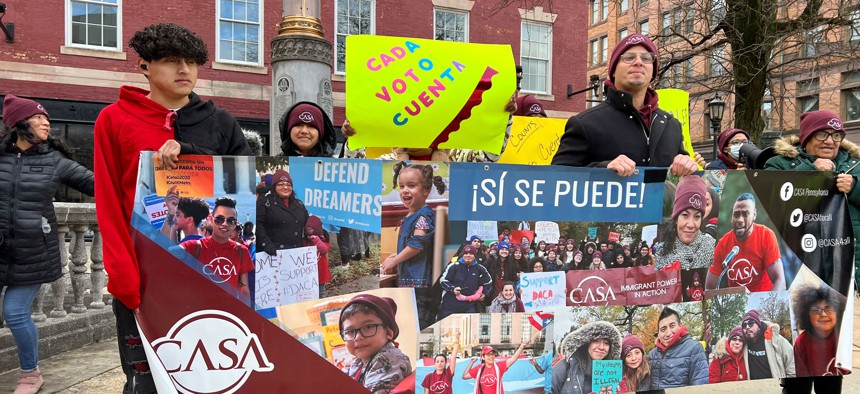
Poll guardians with We Are CASA in York, Pennsylvania in 2022. We Are CASA

As Election Day approaches, immigrant advocates across Pennsylvania agree: Given the current political climate, being naturalized or even American-born may not guarantee a smooth voting experience at the polls on Nov. 3. That unease has ramped up in the election cycle’s final week, as cities around the U.S. have reported an uptick in federal immigration enforcement.
That’s why advocates for foreign-born and non-English speakers are adopting several strategies to ensure constitutional rights at the polls. Those strategies include voter education, advice on alternative ways to vote, and civilian vigilance at polling sites on Election Day.
We Are CASA, a national immigrant advocacy organization, plans to station some 500 “poll guardians” – roughly split between local volunteers and others busing in from Maryland and Washington, D.C. – at 200 election sites in York, Lancaster, and Dauphin counties. These Pennsylvania regions have large communities of people from the Dominican Republic, Haiti and Puerto Rico (the latter are U.S. citizens, but advocates say they are vulnerable as Spanish-speaking newer arrivals).
Trained poll guardians “are going to stand there just to watch for any elections-related shenanigans,” including voters improperly turned away, said Jossie Flor Sapunar, We Are CASA’s national communications director. “Any funny business that prevents a voter casting a ballot, (poll watchers) are going to document it – and things that need to be escalated will be escalated.”
In previous elections, the organization’s documentation of systematic barriers faced by Spanish-speaking voters led to a 2023 settlement requiring bilingual sample ballots in York County’s 161 precincts.
Two years into the Trump administration’s wide-ranging crackdown on immigration – including raids and detentions in immigrant communities by the U.S. Immigration and Customs Enforcement, known as ICE – fear and distrust is running high. Rumors have been circulating about ICE’s presence at polling places, and advocates say they are working to quell anxieties and offer safe alternatives for those unwilling to risk exposure.
“Even people that are U.S. citizens are intimidated,” said Sapunar, alluding to the erroneous detentions and even the deaths of U.S. citizens during ICE activity in various states. “You can’t see a police officer and feel completely secure anymore.”
“So when it comes to elections – when it comes to practicing your constitutional right to cast your ballot as a U.S. citizen – people like Puerto Ricans, who are Spanish-dominant, people who are newly naturalized, all of these groups … are now also targets of law enforcement.”
Pennsylvania law prohibits police from coming within 100 feet of polling sites, but state Rep. Malcolm Kenyatta, a Philadelphia Democrat, has introduced legislation that would expand that prohibition to all law enforcement, including federal agents.
His colleague, state Rep. Johanny Cepeda-Freytiz, a Berks County Democrat and chair of the Pennsylvania Legislative Latino Caucus, said she expects to see markedly different voting patterns among Hispanic residents this year.
“I think you’re going to see many more Latinos voting by mail,” she said. “Ultimately, it’s about safety. We’ve seen the reckless behavior of ICE agents.” The impersonal nature of mail ballots not only feels safer, but also makes voters less likely to have their citizenship status questioned, she explained.
To help in-person voters feel more comfortable, Cepeda-Freytiz said she has been encouraging people to help at polling places, and pushing to educate constituents about their voting rights.
“Whether you were born here or naturalized here, the fact that you are of color and perhaps speak English with an accent is already a target in the United States of America that we are living in today, unfortunately,” she said.
The Pennsylvania Immigration Coalition has also prioritized voter education, said Executive Director Jasmine Rivera. Her nonpartisan organization’s outreach goes beyond voting rights and constitutional guarantees to acknowledging the particular risks of the current moment – and offering practical strategies to offset those risks.
Rivera said her team is reaching out to naturalized voters about the possibility of ICE being deployed to poll locations, or other immigration enforcement operations. She encourages mail voting for vulnerable citizens, “prioritizing safety above all else.”
The coalition recently hosted a series of nonpartisan “ballot parties,” where voting materials were translated into a range of languages. “The No. 1 reason why immigrant voters are hesitant to utilize vote by mail is overwhelmingly language access,” Rivera explained. The No. 2 reason, she added, is distrust in the mail system.
“So we’re equipping folks with the information on how to return a ballot directly to the county, whether that is a drop box, the Board of Elections office, the satellite office,” she said. “We’re making sure that people have all of the information, so they can make a fully informed decision on how they want to vote.”
While ICE isn’t historically a common presence at polling places, federal election monitors from the U.S. Department of Justice are expected at certain voting sites across the commonwealth, as they have been in past elections. But advocates like Sapunar say their presence feels more threatening given the aggressive nature of President Donald Trump’s immigration and judicial activity.
“What do they want to do? What’s the purpose of having them there? When it’s clear that the Trump administration has a very specific agenda, how can we say that the DOJ is going to be impartial in making sure that these ballots will be counted correctly?” she asked rhetorically.
“There’s a lot of questions that are swirling around … That’s why we put out these poll guards,” she added. “To have impartial, nonpartisan people that are not associated with any government function, just to stand, watch, be vigilant – and make sure that every vote gets counted.”