

News & Politics
‘The people have spoken’: Shapiro defeats Garrity in PA’s race for governor
Shapiro secured another term as governor on a night when Democrats also won control of the Pennsylvania Senate.
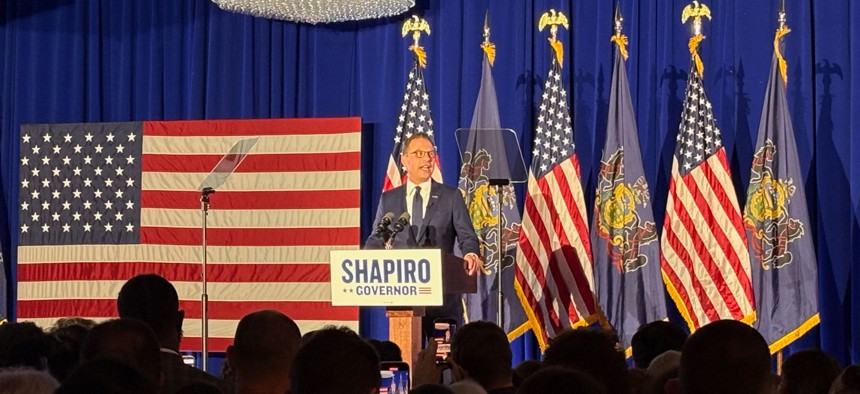
Gov. Josh Shapiro speaks to supporters at an election night watch party. Justin Sweitzer

Pennsylvania Gov. Josh Shapiro has secured another four years as governor, with The Associated Press calling the 2026 gubernatorial race in Shapiro’s favor one minute after polls closed on Tuesday night.
Shapiro, who won on a night when Democrats also won control of the Pennsylvania Senate, faced a challenge from state Treasurer Stacy Garrity, the Republican Party nominee.
Speaking to supporters at an election night watch party in Cumberland County, just across the Susquehanna River from Harrisburg, Shapiro thanked voters for their support and said Tuesday was a “good night for our commonwealth.”
“The people of Pennsylvania are speaking with resounding force. You left no doubt: You are done with leadership that fails to make life better,” he said. “Tonight, the people have spoken. They want us to raise the minimum wage to $15 an hour. They want us to build more housing and strengthen our infrastructure. They want us to invest in our kids, our cops, and our communities. They want us to enshrine abortion rights for women in the Constitution.”
Shapiro, whose “Get Stuff Done” mantra has been a hallmark of his first term in the governor’s office, said early election returns show he will retain strong Democratic allies in Harrisburg.
“The way things are starting to look tonight, I think I’m going to have plenty of GSD Democrats by my side,” he said.
Shapiro leaned heavily on his first-term record throughout the campaign.
In his first term as governor, Shapiro secured funding increases for public schools, as well as state funding for new Pennsylvania State Police cadet classes. He also signed into law an expansion of the state’s Property Tax/Rent Rebate Program, increasing both the dollar amount of rebates and the number of people eligible for the program. He also established a new Working Pennsylvanians Tax Credit with the 2025-26 state budget. In this year’s state budget, he also secured a cost-of-living adjustment for state pensioners, including teachers, police officers and firefighters.
Garrity made public opposition to data center development a key pillar of her campaign, frequently knocking Shapiro over his support of data center projects in the state. However, she failed to gain traction, consistently trailing Shapiro in public polls and fundraising.
Shapiro held a wide lead over Garrity in the public polls. A September poll from The New York Times and Siena University showed Shapiro leading Garrity by 20 points, a gap that only seemed to grow as the election got closer. A Quinnipiac University poll conducted during the first week of October showed Shapiro leading Garrity 59% to 34%, and a mid-October Franklin & Marshall College poll showed Shapiro leading the Republican challenger 59% to 36%.
Shapiro also vastly outraised Garrity throughout the 2026 election cycle. Since 2025, Shapiro reported more than $63.7 million in total contributions, while Garrity raised $10.6 million in contributions since the beginning of 2025.
Shapiro said Garrity called him Tuesday night to wish him well. After conceding the race, she told supporters that she wished she had more financial support earlier in the race.
“Certainly, I wish we had more resources come in earlier,” she said, according to The Philadelphia Inquirer. “We did do well after the debate, but that was a little late, Oct. 7, when the, you know, the early voting had already started.”
“Obviously there could have been more money, there could have been more advertising, there could have been a lot of other things, but I never relied on anybody else,” she added.
In the weeks leading up to Election Day, Shapiro focused his attention on flipping state legislative and congressional seats across Pennsylvania. He embarked on a 10-day bus tour in the final days of the election cycle, campaigning for Democratic congressional candidates in competitive districts as well as for state legislative candidates.
On the campaign trail, Shapiro urged voters to elect a Democratic trifecta in Harrisburg, with Democrats currently controlling the governor’s office and the state House of Representatives.
Democrats won that trifecta on election night, taking four GOP-held Senate seats and flipping the chamber for the first time since 1993.
Shapiro said a Democratic-controlled Senate will allow lawmakers to pass legislation that raises the state’s minimum wage to $15 an hour, as well as a proposal to allow childhood sexual abuse survivors to sue their abusers. The governor said codifying abortion rights in the state constitution and investing in housing and infrastructure will be other major priorities.
“For the first time in decades, Pennsylvanians used their power tonight to flip the state Senate so that we can deliver even more results for our communities,” Shapiro said in a statement. “Now, with a Democratic trifecta, we’ll be able to get even more stuff done – from raising the minimum wage and lowering costs, to giving survivors their day in court, to building more housing and codifying abortion rights.”
In the 6th Senate District, Democrat Eileen Hartnett Albillar defeated Republican state Senate Frank Farry, while Lehigh County Controller Mark Pinsley defeated GOP state Sen. Jarrett Coleman in the state’s 16th Senate District. Democrat Chris Thomas defeated state Sen. Tracy Pennycuick in the 24th Senate District, and Brian Wrightson beat Republican state Sen. Rosemary Brown in the 40th Senate District. Democratic state Sen. James Malone was defeated by GOP state Rep. Tom Jones, who flipped the 36th Senate District back into Republican control.
Come January, Democrats will hold a 26-24 majority in the chamber.
Speaking to supporters Tuesday night, Pennsylvania Democratic Party Chair Eugene DePasquale celebrated Shapiro’s win and credited the governor and the Pennsylvania Democratic Party’s work with improving the party’s voter registration efforts this cycle.
“With the help of Gov. Shapiro, from Lt. Gov. Austin Davis, the tremendous staff of our party, and the tremendous volunteers all over the state, we have now won the voter registration battle for 14 straight months,” DePasquale said, noting that the party’s statewide success on Tuesday night puts Democrats in a strong position heading into the presidential election in 2028.
“There is no map for Democrats to win the White House without Pennsylvania – and we are showing here tonight we are on the path to turning Pennsylvania blue.”
Shapiro’s running mate, Lt. Gov. Austin Davis, framed Democrats’ gubernatorial victory as a rebuke of Republican policies in Washington, D.C.
“We’ve seen federal attacks that undermine the very fabric of our democracy. We’ve seen our neighbors live in fear, manufactured by mask agents to sow seeds of chaos. We’ve seen the rich and powerful pull further ahead while families struggle to put food on the table,” he said. “In spite of the pain we’re feeling, Pennsylvanians showed up to the polls to put our country on a better path forward.”
Shapiro said Pennsylvanians communicated a sense of hope and optimism with their vote.
“You showed that together, our small voices can make a big statement about the changes we all want to see, about the results we deserve, about the kind of place we want to live in and the kind of people we want to be,” he said. So most of all, I want to thank all of you, the people of Pennsylvania, because, even as so many forces are trying to convince you otherwise, you continue to believe that your voice matters.”
This story has been updated to include results for Pennsylvania Senate races.