
Energy
Year-end Q&A with Senate Pro Tempore Kim Ward
Ward discussed significant policy wins, legislation left on the table and what Harrisburg will be focused on heading into 2026.
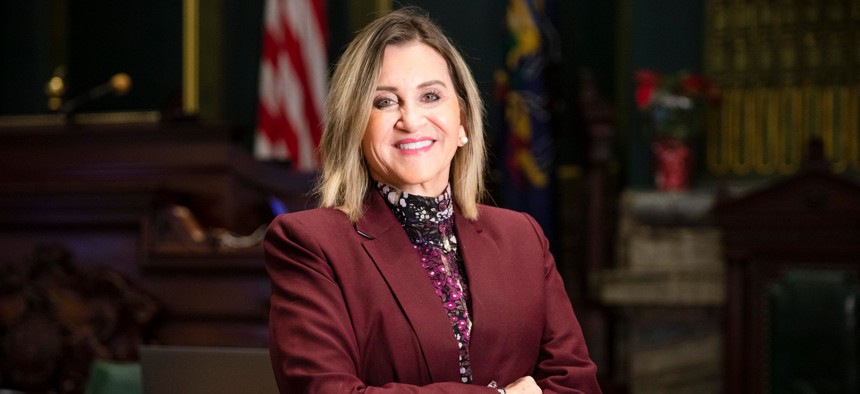
Senate Pro Tempore Kim Ward Amanda Berg

From the annual legislative limbo in Harrisburg to the months-long budget brouhaha, the Capitol beat was buzzing this year for a variety of reasons.
With an eye toward the New Year, City & State spoke with legislative leaders in each chamber to gauge their thoughts on policy wins, legislation left on the table and what Harrisburg will be focused on heading into 2026.
Today’s interview subject: state Senate Pro Tempore Kim Ward.
The conversation has been edited for length and clarity.
What were some of the biggest policy wins for you and your caucus?
The Regional Greenhouse Gas Initiative and permitting reform (measures in the budget) – those were huge, huge issues to help our economy and help us create jobs and a tax base. We didn’t want to spend as much money (on the state budget) as we spent on the Republican side, but when we got those kinds of policy wins, that was worth the spend.
Those were things we’ve been trying to get done for years, and here they are, so I think those are huge. I would also touch on Senate Bill 88, which state Sen. Frank Farry and I prime-sponsored, allowing breast cancer screenings even if you’re not high-risk – it built on what the original bill did. It doesn’t always go to the press, but it will be very important to women.
How did you go into budget negotiations, knowing you didn’t want to impact the Rainy Day Fund – and how much did the long-term structural deficit impact negotiations?
One of the mainstays we would not compromise on was touching the Rainy Day Fund or its interest, because once you touch the Rainy Day Fund, it doesn’t just fill up again. When you’re touching it to spend, nobody will cut spending, so you’re going to touch it again and then in like three years, it’ll be gone – and we really can’t afford to do that.
I think moving forward, we’re going to have more challenges and we’re going to have to cut some places … Every department gets their money and every department gains an interest on that money … I think that if we need to spend, we don’t touch the Rainy Day Fund, but instead we go after the interest that’s being earned, because the last thing we want to do is to raise anyone’s taxes. We’ll need to make some compromises on both sides of the issue, but we're doing so to avoid touching the Rainy Day Fund. On the Republican side in the Senate, we’ll die on that hill.
Can you elaborate on the importance of lowering the Corporate Net Income Tax and implementing an Earned Income Tax Credit for working Pennsylvanians?
We kept the CNIT in check – and this EITC credit, which gives money back to working people who are trying to make ends meet, I think it was a win. They can use that money for whatever they want. I’d like to see that same kind of program for education. There’s money for education, if they wanted to, but I’d like to see something that’s just dedicated education, so that those kids in the failing schools have an opportunity to succeed.
What are your thoughts on the Educational Improvement Tax credit and the education funding that came with the budget?
We added $50 million to the EITC. There is some funding available for kids; we’d like to see it expanded. We have historic spending on education. The Democrats continuously say, ‘The court case said so…’ – no, the court case did not say so. The Commonwealth Court case on education spending said that we had to fund education adequately and we have to have a better formula. It did not say we need to spend an additional $526 million per year. The Basic Education Commission, which was controlled by the Democratic side of the aisle, said so, and the Republicans on that commission all voted no. They need to stop hiding behind the court decision, because that’s not what the court says.
Two major discussion points have been the potential legalization of adult-use cannabis and the regulation of skill games. Where do those negotiations stand and how critical is it to consider finding new revenue sources for the state?
The governor recently stated that there’s no budget without a recurring revenue source for transportation. We all love transportation – we have roads, we have bridges and we have public transportation. We have to find a way to fund that without raising people’s taxes. I do think that working within the gaming law to do something with the skill game issue is one of those possible sources. I haven’t seen legalized marijuana rise to the level of everyone’s talking about it in the legislature … I’m not saying it’s not coming, but I have not seen it yet.
Considering how long the budget impasse lasted this year, how are you going into this next budget cycle differently to ensure local funding streams aren’t disrupted again?
I look at this going into the next budget session as a continuation of the work we just finished. We’ll have forecasts of what we think we’ll be getting in revenue …The governor is going to give his address in two months. It’s like the continuation of what we just did, and I do think that this needs to start earlier. And we need to stay at it, stay at the table, and stay at it earlier, earlier and earlier.
You can’t deal directly just with the governor, because he agrees with everything you say. He just wants to sign a budget, but state Rep. Matt Bradford does not, and he has to move something. To protect all of our time, it needs to be three parties, or it just needs to be Joe Pittman, Bradford, Joanna McClinton and I, and we see what we can agree on. The governor said, ‘If they agree, I will sign it.’ We just need to make sure that we go early, we go often, and we make sure that everybody is in the room that needs to be in the room.
What priorities do you have on the horizon for 2026?
You don’t know what’s going to pop up. But we talk about skill game regulation, we talk about going further with permitting reform. We also consider what we can do with our tax structure to help these businesses. There are things like that, but they’re not the things that are hitting the front page right now.
Energy will always be an issue for us. We will continue to work in that realm, because, as you know, we sit on the second-largest gas reserves in the whole entire country. That’s independence, that’s jobs, that’s a tax base – and I think that stays on the front burner.
NEXT STORY: A Q&A with PA House Speaker Joanna McClinton