
Education
New documentary focuses on plight of early childhood educators in PA
“The Hands That Shape Tomorrow,” directed by Emmy-winner Kyra Knox, shows the positive impact of a guaranteed income initiative program on teachers – and the fallout when it ends.
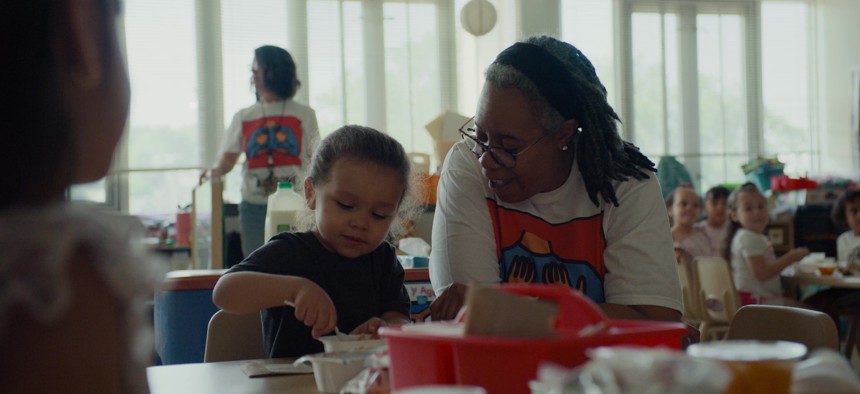
Renee Talley, a child development specialist at the Gordon Literacy Center in Coatesville, is one of the subjects of "The Hands That Shape Tomorrow." JTWO PRODUCTIONS

In just 21 minutes, a new documentary by award-winning filmmaker Kyra Knox manages to shine a light on the precarious livelihoods of the professionals providing early childhood education to those who need it most, and on a short-lived program that proves overwhelmingly effective at helping those teachers find more stability in both their personal and professional lives.
“The Hands That Shape Tomorrow,” which, in addition to being directed by Emmy winner Knox, is executive-produced by professors Laquana Cooke and Jeremy C. McCool of the Media Ed-Tech Institute. Cooke and McCool were told about an 18-month pilot program taking place at the Gordon Literacy Center in Coatesville, a Chester County city 39 miles west of Philadelphia. The teachers at the preschool, which provides early education for 320 3- to 5-year-olds, received an additional $500 per month through the project.
As the documentary shows in detail, the additional funds, provided through a partnership with the health and human services organization PHMC and the Malvern-based investment management firm Vanguard, proved to be literally life-changing for the recipients featured in the documentary. The benefits of a guaranteed income initiative like the one in Coatesville are far from unique and are a primary driver of a surge in their popularity, including legislation introduced in the U.S. House of Representatives in October to federalize a guaranteed income pilot.
For an early childhood education teacher in Pennsylvania, whose average salary hovers around $30,000, it’s easy to see how the boost provided by the project – which amounted to a 16% raise – could make such a difference. What the team behind the documentary wants people to think about – especially those who can do something to make guaranteed income initiatives – is: Why are the people entrusted with children at this crucial age paid such low wages for such an important job, and how can programs like the one featured in the documentary become more long-lasting?
For Cooke, that means deploying the documentary to, she says, “continue a conversation to look at this very complex financial structure more creatively and innovatively, and get these … educators and policymakers to think more creatively about how we can create a more sustainable pathway for supporting educators that's not contingent on raising the minimum wage.”
The return on the project’s investment is impressive for the teachers: In addition to a 98% retention rate, the professionals whom Knox followed at the school were able to move from living paycheck to paycheck to finding stable, improved housing, saving more money, and plowing even more funds into their classrooms and students. Their love of and commitment to their community and its children makes the inevitable end of the project that much more devastating – and essential – to watch.
The filmmakers will be on hand at three preview screenings in the Philadelphia region over the next few weeks – the first takes place Feb. 18 in Downingtown – for question-and-answer sessions with audience members.
McCool knows that one short documentary won’t open the floodgates of funding for pre-K, especially when public school dollars are such a flashpoint at every grade level. “It's more so that all of education is underfunded already,” he said, “so I don't necessarily think it's taking it from here and moving it here. I think there needs to be more funding for education as a whole. That is definitely a long-term goal … a short-term goal is just to educate people on the impact of early childhood educators and their importance. We hope for (viewers) to have a deeper appreciation for what it is that they do.”
For Knox, the success of calling attention to the work and dedication of early educators to their craft and their charges can be measured in both big and small ways, whether it's politicians renewing focus on salaries and funding or everyday Pennsylvanians dropping off needed supplies.
“My job is to tell the stories of the underrepresented communities and make sure that their voices are loud and clear for the lawmakers, the change-makers,” she said. “Maybe this documentary will make even a small difference, where the teachers don't have to pull the money out of their own pockets for their classrooms.”