
Capitol Beat
House lawmakers advance measure to tax digital advertising platforms
Supporters say the legislation could generate hundreds of millions of dollars in annual revenue for the state.
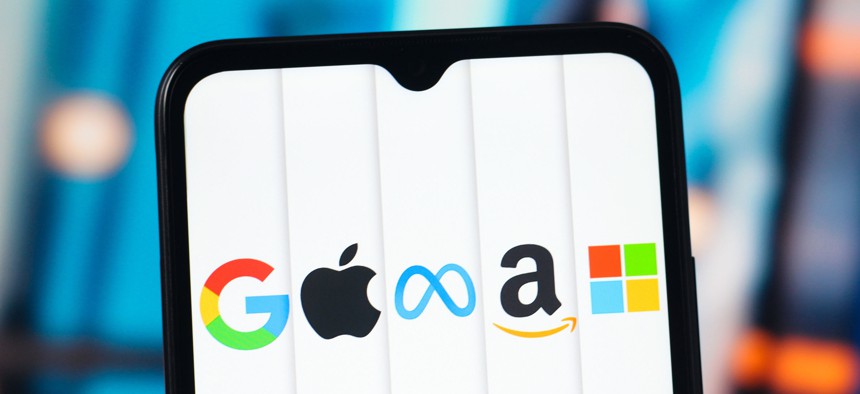
Lawmakers in Pennsylvania advanced a measure Wednesday that would tax digital advertising platforms like Google, Meta and Amazon. Thomas Fuller/SOPA Images/LightRocket via Getty Images

Lawmakers on the Pennsylvania House Finance Committee voted along party lines Wednesday to advance a measure that would levy a tax on digital ads and potentially generate $500 million in new revenue for the state.
The vote spurred plenty of discussion among state legislators, with proponents of the digital ad tax bill saying it would modernize an antiquated state tax and create a new source of recurring revenue, while critics worry that the tax on digital advertising platforms could get passed on to small businesses and consumers, despite being targeted toward Big Tech companies and large corporations.
How would the digital ad tax work?
House Bill 1678 wouldn’t create a new state-level tax, but would instead extend Pennsylvania’s existing 5% gross receipts tax to cover companies and corporations that provide digital advertising services in the state. That includes banner advertising, search engine advertising, interstitial advertising and other advertising services.
Democratic state Rep. Elizabeth Fiedler, the prime sponsor of the bill, said during an April public hearing that the tax would apply to large technology companies like Google, Meta, Amazon and Microsoft – and could raise between $300 million and $600 million per year, if enacted.
One of the bill’s cosponsors, Democratic state Rep. Aerion Abney, said Wednesday that Pennsylvania’s tax laws should be updated to reflect major economic shifts that have occurred due to the advent of the internet and digital platforms.
“Pennsylvania’s gross receipts tax – it dates all the way back to the 1860s,” he said. “The gross receipts tax has been modernized since that time to include things like the telecommunications industry. This legislation looks to modernize the GRT to recognize the fact that we live in the 21st century, and we have the internet and we have apps.”
Proponents of the bill cited a recent report from the Interactive Advertising Bureau and PricewaterhouseCoopers that found that total digital advertising revenue in the U.S. rose by 13.9% in 2025 to a record $294.6 billion.
“I want to be clear that this legislation doesn’t cost working people in our districts a penny. It just calls on those huge for-profit corporations to pay their fair share,” Fiedler added at the April public hearing, noting that the tax revenues could be used to fund a number of priorities, including roads, bridges, schools and mass transit. “Unfortunately, we’re heading into some very tough budget times for our state. I think we need to be creative, thoughtful and have open minds when it comes to sources of revenue, especially sources of revenue that protect our constituents from seeing any kind of tax increase.”
As it’s currently written, the legislation includes an exemption for advertising on broadcast and news media platforms.
Ray Murphy, the co-leader of a progressive organization known Pennsylvanians for Accountability from Yass, Billionaires and Corporations, or PAYBAC, said in a statement that HB 1678 would help address the state’s structural budget deficit at a time when the state’s June 30 budget deadline is drawing near.
“The corporations building data centers, driving up utility bills, and profiting off our data have to pay their share. With budget negotiations in their final stretch, passing the digital ad tax would bring in $500 million in new revenue from Big Tech, helping to close the budget gap right now – without raising costs for working people,” Murphy said. “There’s no excuse to leave that money on the table. We urge all members of the House to vote yes on HB 1678, and for the Senate to advance its companion bill, SB 1199.”
Do other states tax digital advertising?
Maryland became the first state in the nation to enact a tax on digital advertising when the its legislature voted to override a gubernatorial veto in February 2021.
Maryland’s digital ad tax applies to companies with annual gross revenues of $100 million or more, with the rate increasing relative to the share of revenue a corporation derives from digital advertising. But while Maryland made history with the passage of its tax on digital advertising platforms, the law has been the target of several lawsuits challenging its legality, potentially serving as a cautionary tale for Pennsylvania lawmakers.
Last October, a U.S. District Court judge struck down a portion of the law that prohibited companies from notifying consumers of the tax and passing it on to customers.
In Utah, state lawmakers passed legislation to tax digital ads targeted to individual internet users; Gov. Spencer Cox signed the bill into law on March 25 of this year. Utah’s legislation takes a different approach by not specifically mentioning digital advertising, which could help it avoid the legal challenges Maryland faced, according to Governing.
According to the legislation, revenue generated from Utah’s targeted ad tax can be used for child literacy programs, youth sports and recreation, mental health services for children, and adoption and foster care services, among other uses.
Lawmakers express concerns with a digital ad tax
Legislators on both sides of the aisle expressed concerns with aspects of the proposed digital ad tax.
Democratic state Rep. Arvind Venkat voted in favor of the legislation on Wednesday, but said he had concerns about both the legal challenges experienced by other states, as well as the possibility that such a tax could get passed on to businesses and consumers.
“I do have concerns from the hearing as to the experience in other states with regard to this tax, as to whether it really is confined to these large corporations or whether it gets passed on to the advertisers – which can include small businesses,” Venkat said, adding that he also worries the federal Internet Tax Freedom Act could preempt state efforts to tax digital goods and services.
Republican lawmakers also expressed reservations about the bill. GOP state Rep. Leslie Rossi worried that large tech companies and digital platforms could pass on the costs of the digital ad tax to small businesses that don’t have the ability to absorb them.
“HB 1678 is aimed at large digital platforms, but small businesses may not be able to absorb these costs like a national competitor is able to do,” Rossi said Wednesday. “In rural areas, such as my district, small businesses need to advertise to survive, and small business is the lifeblood of many of our communities. This added tax would certainly have an impact, resulting in lower profits for small businesses, and the consumer would end up paying higher prices.”
State Rep. Keith Greiner, the Republican chair of the House Finance Committee, said lawmakers should be working to help businesses of all sizes succeed.
“We don’t have one state yet that has been successful with initiating a tax like this,” he said. “It’s very frustrating; this anti-business attitude has to stop here in Pennsylvania, too. We need to be promoting business and supporting big business and small business – and not working against them.”
With the bill successfully advancing out of committee, it now awaits a vote on the House floor, and would also have to advance through the state Senate in order to make it to Gov. Josh Shapiro’s desk.