

General Assembly
Flocked and loaded: Pennsylvania lawmakers look to regulate license plate-reading cameras
Amid heightened anxieties and a nationwide outcry over the use of automated license plate readers, state legislators are introducing bills to regulate so-called Flock cameras.
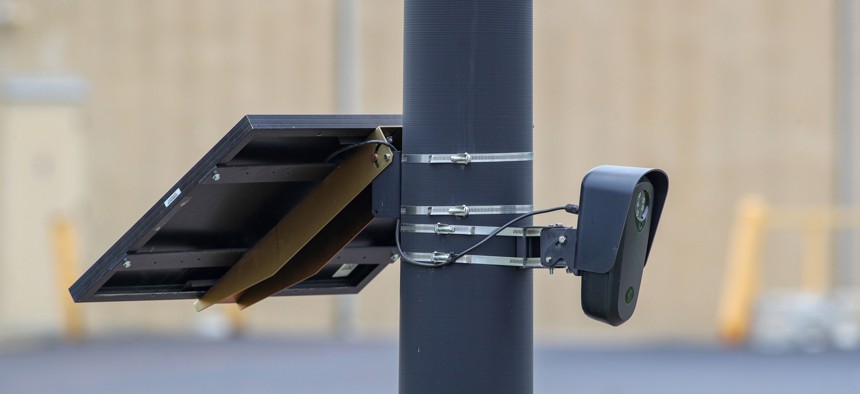
A Flock Safety camera is seen at the Buckhorn Plaza shopping center near Bloomsburg, Pennsylvania. Paul Weaver/SOPA Images/LightRocket via Getty Images

An increasing number of Pennsylvania state lawmakers are backing efforts to regulate the use of Flock cameras and automated license plate readers – a push that comes amid escalating anxieties around mass surveillance and government overreach linked to the technology.
Flock’s AI-assisted automated license plate readers, or ALPRs, are used by law enforcement, businesses and communities to capture vital vehicle information – including a vehicle’s license plate number, make, model, color, bumper stickers, dents, exact locations and timestamps. Flock customers can tap into a national network of 120,000 cameras that proponents say have been used to solve a range of crimes, including missing-person cases and vehicle thefts.
However, misuse of Flock cameras and ALPRs has led to mounting public pushback. The Washington Post reported this month that more than 50 law enforcement officers across the country have been charged or accused of misusing ALPRs to stalk or surveil people. As Pennsylvania residents have become more aware of the prevalence of Flock cameras in their communities, they’re urging local officials to remove the cameras and, in some cases, are doing it themselves, cutting them down and replacing them with American flags in acts of protest.
Deepening apprehensions around Flock cameras have prompted several state lawmakers to introduce proposals to regulate the use of Flock cameras and ALPRs statewide.
Democratic state Rep. Tarik Khan is partnering with Democrats and Republicans on legislation to establish guardrails for ALPR use and license plate data. In an interview, Khan told City & State that misuse of license plate data is tapping into the public’s existing concerns about a “rapid expansion of tech without clear guardrails.”
“It’s not just restricted to one state that’s using it. This is everywhere, and there are no clear guardrails on this technology,” Khan said. “No one wants constitutional rights to be violated, especially in terms of privacy.”
According to DeFlock, a nonprofit project that tracks ALPRs across the country, Pennsylvania has at least 1,752 ALPRs. Khan acknowledged that there are legitimate uses for ALPR data, but said lawmakers need to act to curb abuse of the cameras and data.
“With this technology, if they’re using it to go after a stolen car, great,” he said. “But if someone’s using it to track how many times I’m going to Insomnia Cookies for a late-night run, that’s a problem.”
Khan said his legislation, which has yet to be formally introduced, seeks to establish parameters on who can use ALPR data, what the data can be used for and how long the data can be stored. His bill also seeks to improve transparency around how ALPR data is used, while also establishing civil penalties for those who misuse data from Flock cameras and other ALPRs.
“We have to make sure that there are clear guardrails in place so that people’s rights are not being violated – that people are not being spied on and surveilled,” he added.
Other lawmakers in the General Assembly have proposals regarding ALPRs, including Republican state Reps. Brenda Pugh and Jamie Walsh, who plan to introduce a bill that would prevent private unauthorized disclosure of ALPR data by vendors.
“ALPR systems have become valuable law enforcement tools for locating stolen vehicles, apprehending dangerous fugitives, locating missing persons, and solving serious crimes,” the lawmakers’ co-sponsorship memo reads. “Many law enforcement agencies, however, rely on private vendors to both operate these systems and store the resulting data. Without clear statutory safeguards, an ALPR system vendor could sell or transfer sensitive information – or enable third parties to access it – without the knowledge or authorization of the law enforcement agency that collected and owns the data, with the vendor serving only as its custodian.”
Their legislation would “prohibit a vendor from selling, disclosing, transferring, licensing, or otherwise providing access to ALPR data” without authorization from the contracting law enforcement agency. Pugh and Walsh note in their co-sponsorship memo that their bill would not restrict legitimate information-sharing between law enforcement agencies, nor would it interfere with investigations, task forces or efforts to apprehend fugitives.
Facing growing backlash across the nation, Flock Safety this week announced a slate of new safeguards, including shortening its data retention period from 30 days to 7 days.
“Today we’re cutting our default to seven days,” Garrett Langley, the founder and CEO of Flock Safety, said in a video posted to Flock’s website on Aug. 13. “That means every image our cameras capture is by default purged from the customer’s database after one week, unless it becomes evidence in an active criminal investigation, in which case it enters evidence mode and is retained as the law requires.”
Langley said Flock’s most important changes aim to address misuse of its tools. He said Flock’s “Audit Assistance” tool, which detects abnormal behavior on its platform and flags it for review, will automatically lock users out of its system when their behavior is deemed as potential misuse. The company will also now require specific case codes for all law enforcement searches, though law enforcement can bypass those case codes in emergency situations. In those instances, emergency searches will be flagged for administrative review, Langley said.
Langley also called on state legislators across the country to pass laws that require audits on all law enforcement data systems, as well as laws that raise penalties for officers who use ALPR systems to stalk or surveil individuals.
“An officer who uses these systems to stalk someone or settle a score should face severe criminal charges and lose their certification permanently,” Langley said.