

Transportation
SEPTA’s tumultuous 2025: Part I
Philadelphia’s public transit system had its share of twists and turns this calendar year
SEPTA General Manager Scott Sauer speaks at a press conference at the agency’s headquarters in Center City Philadelphia on August 10, 2025 Commonwealth Media Services

2025 has been a memorable year for Pennsylvania public transit, for better – and for worse. While the state’s budget impasse – and ongoing financial struggles for transit systems – created a rocky road for public transit statewide, in the Philadelphia region, the Southeastern Pennsylvania Transportation Authority faced an unsteady fiscal situation and service cuts that would drastically impact the system’s operations in the region.
Here’s the first part of SEPTA’s tumultuous track in 2025 – and how we got here.
April showers
Months ahead of a potential budget impasse and SEPTA shutdown, lawmakers and advocates sounded the alarm and pleaded with the state legislature to prioritize long-term, consistent public transportation funding.
SEPTA announced in April that it would have to implement severe cutbacks due to a $213 million shortfall in the fiscal year. Democrats in the Philadelphia region called for state legislators to act, noting that the massive cuts would eliminate five regional rail lines and 56 bus routes. Additionally, the budget crunch would result in service cuts to the Broad Street and Market-Frankford subway lines and all trolley lines. Finally, fares would rise by 21.5%, service would be reduced by 45%, and all rail service would end at 9 p.m. – unless funding was approved to cover the shortfall.
Transit funding debates revolved around the need for consistent revenue, with some lawmakers proposing a new tax on skill games – which remain unregulated – or on rideshare vehicles, as well as a potential redistribution of sales tax revenue.
Republican leadership in Harrisburg continually pushed back on funding calls by claiming that the system needs to be better managed and that the state itself faces a structural deficit over the next several years – a talking point that would soon loom over all budget negotiations.
The GOP-led Senate, without budging during funding talks, also pointed toward the $153 million Gov. Josh Shapiro unilaterally moved from federal highway funds to SEPTA late last year as part of a stopgap solution for the system. Pennsylvania Secretary of Transportation Mike Carroll also called for broader state funding, making the case that there are 53 public transit agencies across the commonwealth’s 67 counties – and that it wouldn’t be just cities like Philadelphia that would benefit from a funding solution.
In his budget plan unveiled earlier in the year, Shapiro proposed a 1.75% increase in funding that would add nearly $300 million to transit systems across the state, including an additional $161 million for SEPTA and $39 million more for Pittsburgh’s transit system.
And while Senate Republicans agreed to a one-time funding increase of $80.5 million for mass transit, roads and bridges throughout the state in last year’s budget – which included roughly $51 million for SEPTA – they weren’t on the same track as Shapiro.
Later that same month, an economic study published in part by the Chamber of Commerce for Greater Philadelphia outlined the potential impacts of severe SEPTA cuts, estimating a property value loss of $19.9 million for regional households, as well as major losses in productivity and earnings.
In the same week, just days after Republicans introduced a proposal to privatize SEPTA's bus services, Democratic lawmakers in Harrisburg announced a legislative package aimed at staving off service cuts to public transit systems statewide.
Dubbed the “Transit for All PA Funding Package,” the set of bills, introduced by state Sens. Nikil Saval and Lindsey Williams, alongside Allegheny County state Reps. Aerion Abney and Jessica Benham, sought to increase the state’s daily car rental fee and car lease fee on top of an excise fee on rideshare apps.
May sours
Local electeds and transit advocates continued their calls for consistent public transit funding as legislators faced an upcoming budget deadline at the end of June.
Democratic lawmakers and transit advocates held several press conferences and rallies in support of SEPTA funding, arguing that it would be “fiscally irresponsible” for the legislature to allow SEPTA to remain underfunded compared with other major cities’ agencies. All the talk didn’t lead to much progress heading into the last month of budget negotiations in Harrisburg. The back-and-forth from both sides of the aisle got repetitive quickly, with leaders trading barbs and talking points – and no legislative solution in sight.
Shapiro and House Democrats expressed support for directing tax revenue from skill games to fund transit, but opposition from casino operators and differences over the tax rate on the devices had so far proven to be a stumbling block.
And the Democratic governor’s lifeline for SEPTA turned into a line of demarcation in negotiations, signaling the disconnect between the two parties as the system’s future hung in the balance.
Budget summer bummer
The transit debate heated up as quickly as the temperature. Public transit remained front-and-center amid budget talks in Harrisburg, but as the months went by, no news was bad news. Budget negotiations went well beyond the June 30 deadline, dragging on for months as public transit systems kept their fingers crossed that funds would soon be on the way.
House Democrats tried to get things on the road, passing a transportation funding bill that would boost public transit as well as road and bridge funding, mirroring Shapiro’s proposal from earlier in the year. Democratic lawmakers sought to include road and bridge funding – a Republican sticking point during the budget negotiations – even as GOP lawmakers argued they wouldn’t pass transit funding unless systems proved to be more efficient with taxpayer dollars.
But House Democrats, who passed five different versions of public transit funding during the process, repeatedly called on the Republican-led Senate to bring their proposals up for consideration. One proposal included an accountability provision originally put forth by Republican state Sen. Joe Picozzi, who represents Northeast Philadelphia,
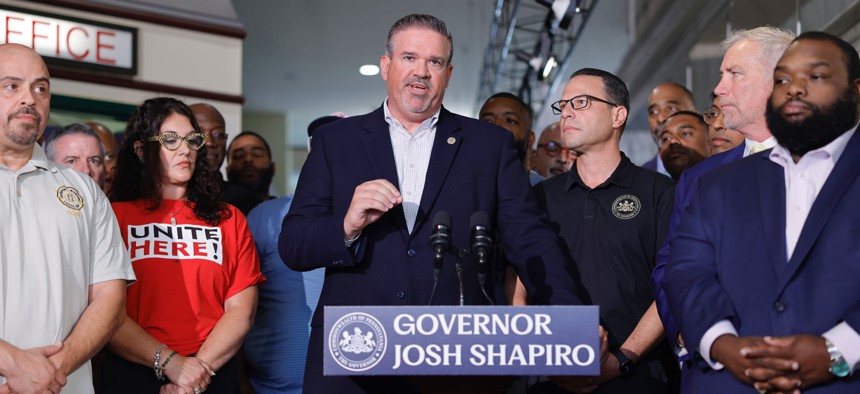
SEPTA General Manager Scott Sauer, who appeared with Shapiro and Democrats at press conferences on several occasions, pleaded that without an influx of funding, the system would face a 20% reduction in service on Aug. 24 – one day before students return to classes in the School District of Philadelphia – and a 45% reduction overall for the fiscal year. And if nothing changed by Sept. 1, fares would go up by 21.5% systemwide and Regional Rail lines would begin to see service cuts.
Shapiro, once again pointing toward the GOP-led Senate, said in early August that the “time to act is now.”
“I presented my state budget to fully fund mass transit along with roads and bridges 187 days ago, and in that time, the Senate of Pennsylvania has been in session for a mere 25 days,” Shapiro said.
Days later, and just two days before SEPTA was set to put drastic service cuts in motion for later in August, the state Senate passed a $47.7 billion budget proposal and separate transit funding plan on Aug. 12 – with both proposals ultimately approved along party lines.
Picozzi said lawmakers shouldn’t “make the perfect the enemy of the good,” adding that the plan would provide for a “better, safer, more accountable transit system” to ensure SEPTA would remain up and running through major events in 2026.”
Democrats countered that the plan would essentially rob Peter to pay Paul, noting that the measure would shift capital funds needed for infrastructure and renovation projects to cover operating costs.
“It’s taking money from capital funds that will make SEPTA and other transit agencies less safe, less secure and more difficult to run,” Saval said in August, adding that mandated fare increases would be “punishing their constituents because (the Senate GOP refuses) to adopt a serious funding proposal.”
And while Sauer said the proposal “might plug the hole,” it would create new problems for the capital budget down the line.
Senate Republicans, again bringing up Shapiro’s unilateral move last year to provide stopgap funding for SEPTA, seemed vindicated by the proposal’s passage.
"Now you know how we felt back in November when the governor absconded (with) $153 million from road projects and put it into transit,” state Senate Majority Leader Joe Pittman said, referring to previous efforts by Shapiro to redirect funds from highway and bridge projects to provide short-term funding for public transit systems. “Now you know how we felt 15 years ago when Gov. (Ed) Rendell took road money and put it in the transit. Doesn’t feel so good, does it?"
With neither party on the same page, proposals from each respective chamber went untouched as SEPTA’s service cut deadline came and went.
As the school year began in the region, SEPTA was forced to implement a 20% service reduction – putting workers, students and aging adults in a tough spot.
This is the first of a two-part story on SEPTA’s 2025 timeline.