

Criminal Justice
Greek history: A recent timeline of Penn State fraternity scandals
A crackdown on a cocaine-trafficking ring led by Penn State students is the latest in a series of scandals involving fraternities at the state’s only land-grant university.
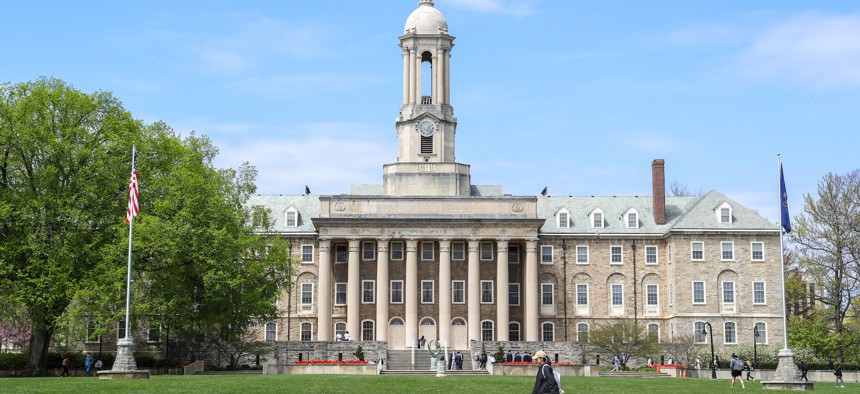
Students walk by Old Main at Pennsylvania State University. Paul Weaver/SOPA Images/LightRocket via Getty Images

The crackdown on a cocaine-trafficking ring at Pennsylvania State University has once again placed a spotlight on Greek life in Happy Valley, as two fraternities were implicated and 13 of the 14 defendants are current or former students.
With Penn State fraternities back in the headlines, City & State put together a brief history of recent scandals involving Greek life organizations at Penn State and the ripple effects that each incident had in State College and beyond.
2026: The Penn State cocaine ring crackdown
On Aug. 17, 2026, Pennsylvania Attorney General Dave Sunday announced charges against 14 individuals in a cocaine-trafficking ring crackdown involving two fraternities and more than a dozen current and former Penn State students following a grand jury investigation. The alleged leaders of the cocaine-trafficking operation – Agostino Abbatiello, a Sigma Chi fraternity brother, and Thomas Robinson, a Delta Upsilon fraternity brother – were the ring’s primary suppliers, obtaining large quantities of cocaine from Philadelphia and New York. According to the criminal complaint, members and pledges of both fraternities helped package and prepare cocaine for resale. One business partner said Abbatiello was believed to be the “largest distributor of cocaine at Penn State University.” Abbatiello, Robinson and two others were charged with felony corrupt organizations, conspiracy, dealing in proceeds of unlawful activity and other offenses, while another eight student-aged defendants face misdemeanor counts of possession and paraphernalia. Sunday described the operation as a “coordinated and highly-profitable drug-trafficking crew revolving around two senior members of the fraternities, other fraternity brothers, and pledges.” Penn State University officials said the Delta Upsilon fraternity was placed on interim suspension pending an investigation. Andrea Dowhower, the university’s vice president for student affairs, said Penn State leaders were “horrified” by the allegations. “Criminal activity, including hazing, such as this has no place at our institution, and we will cooperate with law enforcement in any way we can,” she said in a statement.
2017: The hazing death of Timothy Piazza
Timothy Piazza, a 19-year-old sophomore student at Penn State, died on Feb. 4, 2017, after a night of intense – and ultimately deadly – hazing during his first night of pledging for the Beta Theta Pi fraternity. According to reports, Piazza consumed at least 18 drinks in less than an hour and a half and fell down the stairs at the fraternity house. Fraternity members carried him up the stairs and placed him on a couch, and he suffered several more falls after attempting to get up throughout the night, according to the Gordie Center, a University of Virginia organization dedicated to ending hazing. Fraternity members did not get Piazza help for more than 12 hours after his fall, and he ultimately died of his injuries. Two members of the Beta Theta Pi fraternity faced hazing and reckless endangerment charges and were sentenced to two to four months in prison as a result of Piazza’s death. The incident prompted state lawmakers to pass the Timothy J. Piazza Antihazing Law in 2018, which was signed into law by then-Gov. Tom Wolf. The law created tiered penalties for hazing, required schools, colleges and universities to publicly report hazing violations and provides immunity to those in need of medical attention who participated in hazing.
2015: The Kappa Delta Rho secret Facebook group
Penn State’s Kappa Delta Rho fraternity was suspended in 2015 after investigations into the fraternity revealed that its members were operating invite-only Facebook groups that showed inappropriate images of women – including some who appeared to be passed out, sleeping, nude or partially dressed – and featured conversations about sexual activity with those pictured. The first Facebook group was titled “Covert Business Transactions” and was reportedly shut down after a victim discovered a picture of herself on a fraternity member’s computer. Later, another group titled “2.0” was created in its place. In May 2015, the fraternity was suspended by its national headquarters, and Penn State suspended it for three years. “We base this decision on the sum of misbehaviors exhibited by various members of Kappa Delta Rho,” Damon Sims, then Penn State’s vice president for student affairs, said at the time. “Not every member of the chapter was equally culpable for violation of the University’s expectations for recognized student organizations,” Sims said. “Even so, the sum of the organizational misbehaviors is far more than the University can tolerate from a student organization that seeks its imprimatur.”
2014: Hazing and Marquise Braham’s suicide
In March 2014, Penn State Altoona student Marquise Braham died after jumping off a hotel roof near his family’s home in Queens. Braham, who was a member of Phi Sigma Kappa, had reportedly been in “psychological distress” after being subjected to hazing, according to CNN. Rich Braham, Marquise’s father, said his son had taken pictures of alleged hazing rituals, and that his phone included an image of a dead squirrel that Marquise had been forced to kill. Rich Braham also detailed his son’s participation in an alleged “Locked In” ceremony that involved locking pledges in a closet and forcing them to drink alcohol until they vomited. His family filed a lawsuit against both the university and the fraternity. However, prior to his death, Marquise left a suicide note that read: “I saw this coming since I was a child.” Ultimately, a grand jury ruled that there was no connection between Marquise’s suicide and the hazing he faced, though his family reached settlements with the university, the fraternity and individual defendants, according to the Fierberg National Law Group.
2009: The death of Joseph Dado
In September 2009, Penn State freshman Joseph Dado was found dead at the bottom of a stairwell after being reported missing – roughly 75 yards away from the Phi Gamma Delta fraternity house where he was last seen alive. Dado’s disappearance set off a search that lasted more than 30 hours, until his body was found by university maintenance workers near the entrance of a mechanical room. Dado died from head trauma after a 15-foot fall and had a blood alcohol content of .169%. Two students and two fraternities accused of giving alcohol to Dado were charged with misdemeanors. As a result of Dado’s death, both Phi Gamma Delta and Alpha Tau Omega were suspended, and Alpha Tau Omega was sentenced to pay a $500 fine and serve community service. The fallout from Dado’s death was significant: Penn State’s Interfraternity Council restructured its policies for socials, and then-President Graham Spanier outlined a 30-point plan to combat the university’s No.1 party school ranking, according to Onward State.