
General Assembly
A Q&A with PA House Republican Leader Jesse Topper
Topper talks state budget victories, navigating a divided General Assembly, and his top goals for 2026.
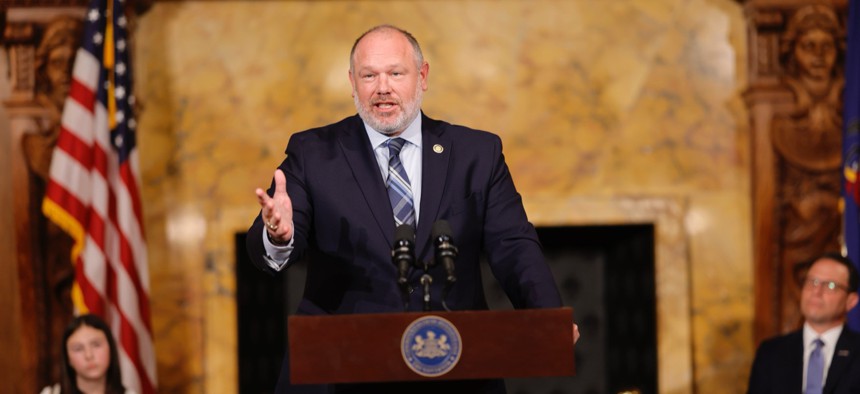
Pennsylvania House Republican Leader Jesse Topper speaks at an April 2025 event in Harrisburg. Commonwealth Media Services

With his first year as minority leader of the Pennsylvania House of Representatives now behind him, GOP Leader Jesse Topper sat down with City & State to discuss an eventful year in Harrisburg.
In a wide-ranging interview, Topper talked about the divided nature of the Pennsylvania General Assembly and the state’s 2025 budget impasse, the significance of removing the state from the Regional Greenhouse Gas Initiative and his top agenda items for 2026.
The following conversation has been edited for length and clarity.
How did your first year as Republican leader go?
I liken it to when I was first elected. I had some background in terms of political involvement, so I knew a little bit – but you don’t really know the scale. And I felt that same way this year. I had an idea of what all went through the leader’s office; you just don’t realize the scale until you actually get into it.
I have had an outstanding and experienced staff that has been immeasurably helpful to me and the caucus – has worked extremely hard to ensure that we’re engaged in decisions that are being made in this building, even from a place in the minority … Obviously, there’s always bumps and hiccups, and you look back and say, “I would have maybe handled this differently, or could have thought a little differently here.” But I think overall, the first year has been successful. I think we’ve had a good agenda, a good message, and we continue to push that.
What is your approach, given how tightly divided this chamber has been?
It is an opportunity. I’ve been in the General Assembly, where we were in the majority, with a significant gap between the minority and the majority, and the majority could largely do as it wished. That’s not the case when it’s this evenly divided. So I think even though we are numerically in the minority, we should be involved. The rules and the actions in the chamber should reflect a divided legislature, and that’s been one of my goals – to ensure that it does. We hold nearly half the seats in the Commonwealth of Pennsylvania. Those people need representation, and I believe we provided it. The conversations and results have shown that our constituents have a voice in the process.
Considering that you’re not controlling the calendar and picking what gets voted on, what are some of the policy wins and accomplishments you’re most proud of, in the budget or elsewhere?
Well, because we’re not in control of the calendar, that really made the budget the area that we could be the most involved with – you see the policy wins that went along with the budget. The abrogation of the regulations around the Regional Greenhouse Gas Initiative is one of the main issues that our caucus has talked about for years. We said, “Look, you can’t really move forward in energy or economic development with the specter hanging over us.” That’s gone. To think of a minority party in a chamber having their No. 1 policy initiative achieved in the first year of a session – I think that shows that we were able to be effective there.
The permitting reform – which was, in fact, historic – I believe that will spur economic growth. Those wins are the ones that I’m very proud of. The budget process – while it certainly took a lot longer than anybody would like, and was painful in many ways – again, reflected divided government. It was always going to be painful to a certain degree because we had two diametrically opposed visions. I say “we,” meaning the two parties, but then you throw the governor in there as well – a lot of different visions of how to get this done. And the fact that we were able to secure a product that received a majority of votes from every single caucus and a governor’s signature reflects significant hard work. I think that, in and of itself, is a victory, too.
What was your approach to budget negotiations?
My approach is that if we are involved in the process, we will provide votes accordingly. If we’re not, you’re going to have to find them somewhere else. That was our message to the governor, the majority party in the House, and to our Senate colleagues. We’re here, willing to work. We have a hard-working caucus that wants to advance policy, and we’re willing to be a part of that. And if we’re not in the room and we’re not in those discussions, then there’s nothing we can do to help. That message was, I think, well received, maybe a little skeptically at first. But throughout the process, everyone involved found us to be honest brokers as a caucus, which helped bring our policy initiatives to the table.
On the budget, I know there were concerns from counties, from schools, rape crisis centers, you name it, about disruptions caused by delayed payments and not receiving that state funding. Is there anything that can be done differently to prevent those types of disruptions in the future?
We all wanted the process to be faster. I wanted to reach an agreement quicker, but I think what I would say to all those entities – whether it’s county government, municipal government – is, do you want the product to be a quality product, or do you want it to be a quick product? This year, I don’t think quality and quick were ever on the table, just because of how different the views are – how much we had to spend, what we were going to spend it on, how we were going to drive the money out, what was going to be the policy that moved us forward economically. The government reflects the people who elected it. They elected almost 50-50 divided government, and that produced what it produced … Ultimately, there were many high-quality outcomes.
There are parts of the budget that are problematic, as you would expect in divided government. It was very difficult to come up with something that both sides would view as high-quality enough to vote for and that could be implemented quickly this year. Hopefully, next year will be different. This was the first year of this specific General Assembly. Hopefully, we can do it quicker this year, but … it did not seem like we would have gotten the quality of the product that we got in November, in June.
What does the change to RGGI mean for the state?
It created market uncertainty, even before full implementation. The fact that it was hanging out there was preventing energy development in Pennsylvania. We weren’t having new energy builds, and because the demand was rising on our grid, we saw rising costs – and we continue to see rising costs.
Anybody you talk to in the energy sector will say, “We need certainty. That’s what we’re looking for. Even if we don’t like every answer, we want to know the answer. We want to know what the market will bear. That’s the only way we can come in with development.” That was never going to happen until a decision was reached on RGGI, or we just said, “RGGI’s off the table” – which I think not only provides certainty, but it also eliminates bad policy. So it really invites that development.
Shifting ahead to 2026 and beyond, what are the top goals and priorities for your caucus?
I think we still see a need to bring our education system to where it should be. In 2025-26, the fact that we have a waiting list all over the commonwealth for career and tech programs is unconscionable to me. The days of trying to shoehorn every kid into a specific education model – they have failed. We have kids falling through the cracks all over our commonwealth, and while we have made some strides over the past couple of years to address it, I don’t think we’ve made enough. We need to figure out a way to address that with a more robust choice program so that parents can decide where their kids can get the best education. Sometimes, that’s within the public school setting. Sometimes, that is career and tech centers within the public school districts. How do we resolve those waiting lists? How do we ensure that our resources are going to things that actually educate kids and prepare them for the workforce that we need them prepared for – prepare them to stay in Pennsylvania? That has been one of our top initiatives; we will continue to do so.
We got a good start and some policy wins this year around reforming our entitlement system so that benefits are there for our most vulnerable while also eliminating the waste, fraud and abuse found within the system. We also want to continue to develop our energy sector. Those were our top priorities this time – and again, we made some strides, but there’s no reason to let our foot off the gas, so to speak, on any of those issues.
How do you see artificial intelligence affecting Pennsylvania’s energy economy?
I think it’s brought a sense of reality to people's understanding of grid reliability and energy costs. We were trending that way anyway, but AI and the development of the data centers have now really moved that timeline up. Maybe we had five years before to solve this looming crisis. That timeline has moved up because these centers are coming in, they need power, and we need to work with that industry to ensure they understand we can’t simply have costs on ratepayers explode while we’re trying to secure power generation.
Working hand-in-hand with our energy industry, I think we can make it work. I think there’s great opportunity here in Pennsylvania. We’re talking jobs, we're talking careers, that's what we’re looking for.
I thought about this the other day. I was pulling into a local convenience store to fill up on gas when I passed two manufacturing plants in my district; both had full parking lots. As an elected official, that’s really what it’s about. We want to ensure that the private sector is working in such a way that our constituents have a way to make a good living. Anytime you see new industry coming into Pennsylvania, you’ve got to view that as an opportunity.
What are some of the challenges you foresee Pennsylvania facing?
If we don’t increase power generation and don't get more shovels in the ground, we’ll continue to see energy costs rise and services stretched. That’s just a bad combination, but that, to me, is the looming crisis. When that happens, you’ll continue to see a demographic shift: people moving out of Pennsylvania, the Pennsylvania population aging, and not necessarily a working population to support the economy's growth again, with a corresponding strain on services. We’ve got to change our demographics in the commonwealth. I think that comes through energy development, and that’s what ultimately will bring costs down.
The state’s structural deficit is projected to expand pretty significantly – from $3.5 billion now to upwards of $7 billion by around 2030. How can the state address that?
Those revenues are kind of like pouring a bucket of water into an ocean. It adds some water. We do a budget every year, and every year, we look at what money is going to come in and what money is spent, and you’ve got two choices. If you’re going to be in a deficit, you add revenue or you cut spending. To me, the only way that we get out of this is with an economy that starts to really hum, because that generates more revenue without raising taxes on the people. I can speak for the 100 people in that room – 101, including me, who have no interest in raising taxes on people who are already fairly highly taxed in Pennsylvania.
I think if you go to the other room and ask them what they want to cut to reduce the budget, you’re going to have an equally difficult conversation. That leaves us with rallying around the idea that we have to grow the economy, and we have to get these impediments – like these ridiculous permitting times and things – out of the way so that the economy can grow.
If the economy grows and we’re still seeing problems, then we will have to address that in our budget priorities – and you really have to sharpen your pencils and figure out how to make it work. But the idea that we’re going to solve this with some utopia of marijuana or gaming – I mean, certainly those things could add revenue to the bottom line – but those things will be spent as soon as that money comes in the door. The way to a sound General Fund is through a structurally sound economy.
Is there an appetite within your caucus for either of those – for cannabis or for skill games?
There’s an appetite. I think it’s a larger one for – and when I say gaming, I mean the whole package. It’s very difficult to pick one industry, one part of the industry, and say what that’s going to provide. If we put a gaming bill on the floor, it should be a gaming bill that looks at the health of the entire industry – from our horse racers, to our casinos, to our skill operators, to our I-gaming, and then what we see with our sports betting – everything has to be part of that conversation. I don’t think you can just single out skill games and say you’re going to get money off of that. The whole industry has to be healthy.
I think there’s less interest in my caucus over marijuana. Now I’m not saying that won’t continue to grow to a certain degree, but I think, as of right now, that’s not close to receiving a lot of support in the caucus, although some members believe it’s a good opportunity. But again, even with that particular conversation, it’s more complex than just saying, “Legalize it.” Well, how? What state model are you going to follow? The Democrats ran something that the industry didn’t even support this year. The devil’s in the details.
We’ll have another budget address in a couple of months. Do you have any priorities for the next budget?
I think the governor, given this first year and first budget, understands our priorities. I’m hoping he will use the budget address to address some of those priorities. Last year seemed somewhat partisan, very much “This is my thought process,” and it didn’t go very well. I think this year we could do a little more collaboration before the address to get a sense of where everyone is, which could help speed up the process and get this done a little sooner.
Do you have any additional thoughts on the 2026 session?
We’ll continue working on our priorities. We have a group that is extremely diligent and hard-working. We’re going to maximize that and continue to be a part of the discussions. That’s what the people elected.
NEXT STORY: Year-end Q&A with Senate Pro Tempore Kim Ward