
Capitol Beat
4 big questions heading into Pennsylvania budget negotiations
As Pennsylvania’s June 30 budget deadline nears, lawmakers will have to grapple with a structural deficit and whether to find new sources of revenue.
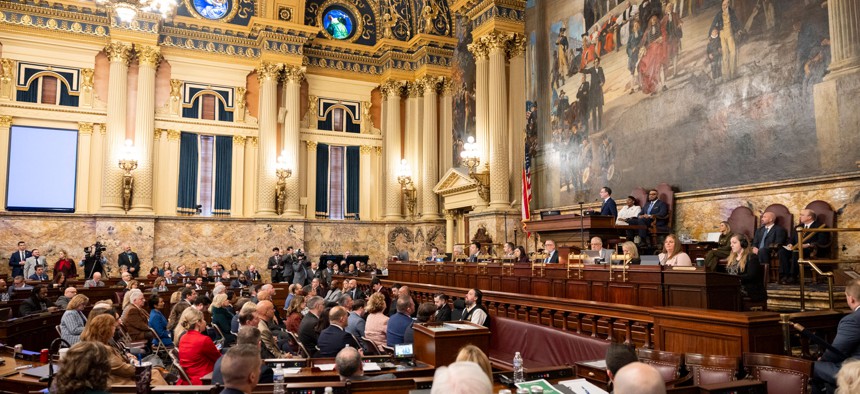
Gov. Josh Shapiro speaks during his February 2026 budget address. Commonwealth Media Services

Summer is nearly here, which means the state’s annual June 30 budget deadline is nearly here, too. With negotiations expected to intensify over the next several weeks as the state’s fiscal year reaches a close, City & State examines some of the key questions looming over this year’s budget cycle.
Will Pennsylvania’s budget be on time?
Perhaps the biggest question looming over this year’s budget cycle is whether lawmakers and the governor will be able to finish a budget by the end of the state’s fiscal year on June 30. The budget for the current fiscal year was signed into law in November 2025 – months after the state’s June deadline had already passed. The same thing happened in 2024, when the state’s budget for the 2024-25 fiscal year was finalized 11 days after the June 30 deadline. And in 2023, the state budget wasn’t completed until December, due largely to a stalemate between Democrats and Republicans over private-school scholarships.
Following his annual budget address in February, Gov. Josh Shapiro convened a meeting with the General Assembly’s legislative leaders to hold early talks on this year’s budget. “We all recognize it took too long last year – and that had real impacts on Pennsylvanians. But we learned some valuable lessons through that process,” Shapiro said during his speech. “We learned that we all need to be at the table, and that we all need to be at the table sooner.”
And despite past disagreements between Democrats – who control the governor’s office and state House – and the GOP-controlled Senate – the early meeting was welcomed by all parties. Whether it bears fruit by June 30 remains to be seen.
Will lawmakers reach agreement on new sources of revenue?
Pennsylvania is facing a long-term structural budget imbalance in which the state’s expenses are expected to outpace revenues over the next several years. That has prompted both the governor and lawmakers to propose several new revenue sources to counter the imbalance.
In his 2026 executive budget proposal, Shapiro proposed three potential sources of revenue: legalizing and taxing recreational marijuana, regulating and taxing skill game machines, and increasing the minimum wage. According to his budget pitch, legalizing marijuana would generate $200 million in annual sales tax revenue, while raising the state’s minimum wage from $7.25 to $15 an hour, beginning in January 2027, would generate an additional $80 million in annual tax revenue. The governor also proposed taxing games of skill in a manner similar to Video Gaming Terminals, also known as VGTs. The budget calls for a 52% tax on gross terminal revenues from skill games, which the Shapiro administration estimates would generate more than $2 billion annually. Democrats in both chambers of the General Assembly have also introduced a separate proposal that would extend the state’s existing gross receipts tax to digital advertising platforms run by Google, Meta, Amazon and others – and potentially generate $500 million in annual revenue.
What will happen to Pennsylvania’s Rainy Day Fund?
In its annual five-year fiscal outlook released in November, Pennsylvania’s Independent Fiscal Office projected that the state faces a General Fund structural deficit of $3.65 billion for the 2025-26 fiscal year – a figure that will grow to more than $7.5 billion by 2030. The commonwealth is anticipated to have roughly $7.7 billion in its Rainy Day Fund at the end of the 2025-26 fiscal year, per the IFO. The money in the fund, also known as the Budget Stabilization Reserve Fund, is reserved for emergencies and economic downturns that lead to unexpected revenue shortfalls.
Shapiro’s budget proposal calls for a $4.5 billion transfer from the Rainy Day Fund to balance the 2026-27 fiscal year budget. Speaking to reporters in February following Shapiro’s budget address, Senate Majority Leader Joe Pittman said that given the state’s financial position, “it’s going to be a difficult task to not have any conversation about the Rainy Day Fund.” With economic forecasts calling for rain, the financial reserves in the Rainy Day Fund could be exhausted as soon as the 2027-28 fiscal year, according to the IFO.
What policy wishlist items will get tucked into the final budget?
While the General Appropriations bill is the main piece of budget legislation that outlines spending levels and allocations, budget-enacting code bills spell out how that money gets spent – and often include policy changes sought by both the governor and state lawmakers.
Shapiro outlined plenty of policy goals in his 2026 budget pitch: housing reforms, a program to fund major infrastructure, and $100 million for a fund dedicated to mitigating the impacts of federal government decisions. And with AI and data centers now a hot topic in nearly every corner of the state, the budget could offer lawmakers an opportunity to enact new laws that balance neighborhood concerns about data center development with the economic opportunities of the burgeoning AI economy.
NEXT STORY: Ask The Experts: The kush push