
Capitol Beat
In wake of high court ruling, Pennsylvanians rally for a skill games solution
Lawmakers, business owners and veterans called for the General Assembly to regulate games of skill.
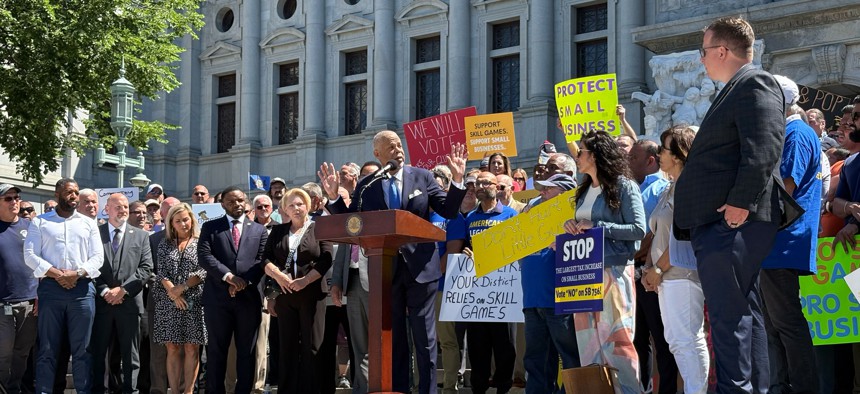
State Sen. Anthony Williams is a sponsor of legislation to regulate skill games in Pennsylvania. Justin Sweitzer

Approximately 350 people rallied on the steps of the Pennsylvania Capitol on Wednesday to call on state lawmakers to pass legislation that would regulate and tax skill gaming machines – a plea that comes in the wake of a recent state Supreme Court decision that found that the gaming machines are, in fact, illegal gambling machines subject to the state’s Gaming Act and Crimes Code.
That ruling prompted proponents of the games – ranging from members of fraternal clubs and fire companies to convenience store operators and state legislators – to convene in Harrisburg and pressure lawmakers to create a legal framework for the gaming machines, which have become commonplace in bars, clubs, convenience stores and other locations. As part of its opinion, the Supreme Court established a 120-day safe harbor period during which law enforcement is prohibited from taking action against skill game operators.
Doug Sprankle, the president of the Pennsylvania Taverns and Players Association and the owner of several grocery stores in Western Pennsylvania, said Wednesday that skill games are a “lifeline” for small businesses and organizations throughout the commonwealth. Sprankle said that without a new law establishing a regulatory framework for the games, everyday Pennsylvanians will feel the brunt of the court’s decision.
“We have less than 120 days until skill games become illegal,” Sprankle said, noting that over 1,000 businesses could be affected by the court’s June 15 ruling. “It’s a big thing for Pennsylvania.”
Democrats and Republicans alike have introduced legislation to tax and regulate games of skill in Pennsylvania. In the state Senate, Republican state Sen. Gene Yaw and Democratic state Sen. Anthony H. Williams are the prime sponsors of Senate Bill 1079, which would create a $500 monthly fee per skill game terminal and limit the total number of gaming terminals in the state to 50,000. They estimate that the proposal would generate $300 million in annual revenue for the state. Democratic state Rep. Danilo Burgos and GOP state Rep. Jonathan Fritz sponsored similar legislation in the state House of Representatives.
In his 2026-27 budget proposal, Gov. Josh Shapiro called on the General Assembly to regulate and tax games of skill with a 52% tax on gross terminal revenues from skill games, which his administration estimated would generate more than $2 billion annually. The Shapiro administration estimates that there are as many as 70,000 skill game machines across the state.
Speaking at the state Capitol on Wednesday, Burgos called a 52% tax rate “nonsense.”
“We need to create an avenue so that these skill games can continue to contribute to our communities and to Pennsylvania. A fair tax is what we’re demanding,” Burgos said. “We need to get to work and provide a fair plan, so that our businesses here in Pennsylvania are protected, so that Main Street is protected – not Wall Street.”
Williams suggested Wednesday that proponents of skill games in the General Assembly could theoretically block a budget deal, and it appears that the issue – and the Supreme Court’s recent ruling – could loom over ongoing budget negotiations.
Following the court’s June 15 ruling, Senate Republican leaders said gaming reform will likely be a “critical piece” of this year’s budget cycle.
“The proliferation of skill games is a matter of public safety which must be addressed, and given the timing of this decision, we believe gaming reform is a critical piece of resolving this year’s budget,” Senate President Pro Tempore Kim Ward and Senate Majority Leader Joe Pittman said in a joint statement following the court’s ruling. “In addition, with the fiscal realities facing our Commonwealth, it stands to reason that new revenue from gaming reform should be directed to the general fund, as the Governor proposed in his 2026-27 budget.”
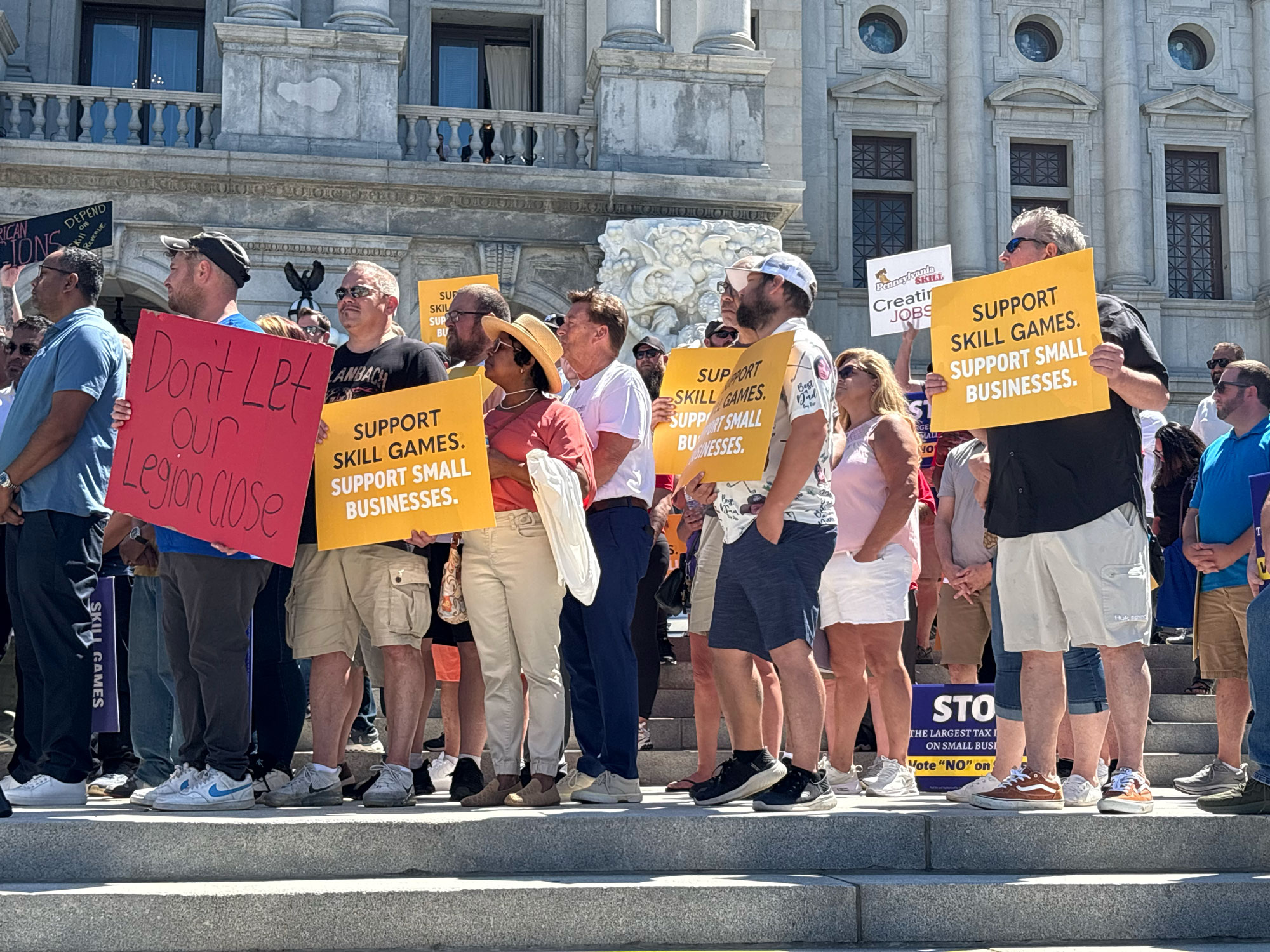
The potential state revenue aside, members of various veterans organizations said Wednesday that skill games allowed them to weather financial hardships and put money back into their local communities.
Mark Coolbough, a member of the Cressona American Legion Post 286 in Schuylkill County, said money from skill games has helped the organization pay for bills and licenses and support community initiatives. “Skill games keep our doors open – period,” he said. Commander Stephen Holmes of the Ephraim Slaughter American Legion Post 733 in Harrisburg said if it weren’t for skill game revenue, his post, which leads backpack drives for local students and programs for veterans, likely would have shut down during the COVID-19 pandemic.
Prior to Wednesday’s rally at the Capitol, Eric L. Hausler, the CEO of Parx Casino, said in a statement that skill games have eaten into casino revenues and that taxpayers have been the biggest victims of the growth of skill games. He accused Pace-O-Matic, the developer behind the Pennsylvania Skill brand of skill machines, of selling small businesses “a bill of goods when they maintained these games were legal and not subject to gaming taxes and regulation.”
“POM claims that these businesses are the victim. The real victims are the taxpayers of Pennsylvania. Casinos pay more than 50% of their gross slot machine revenues in taxes, 34% of which funds property tax relief programs,” Hausler said, arguing that skill games “have drained more than $250 million in total casino gaming taxes from the state that could have funded property tax relief and local and county programs.”
Sprankle said SB 1079 and HB 2213 would be an ideal solution for regulating skill games across the commonwealth by creating a working framework that would eliminate bad actors in illegal gaming.
“It’s important that lawmakers act. We don’t want something that’s rushed; we want something that builds the foundation for our future,” he said.