
Capitol Beat
10 things to know about Pennsylvania’s 2026-27 state budget
Pennsylvania’s latest budget includes more money for public schools, road repairs and a cost-of-living adjustment for pension beneficiaries.
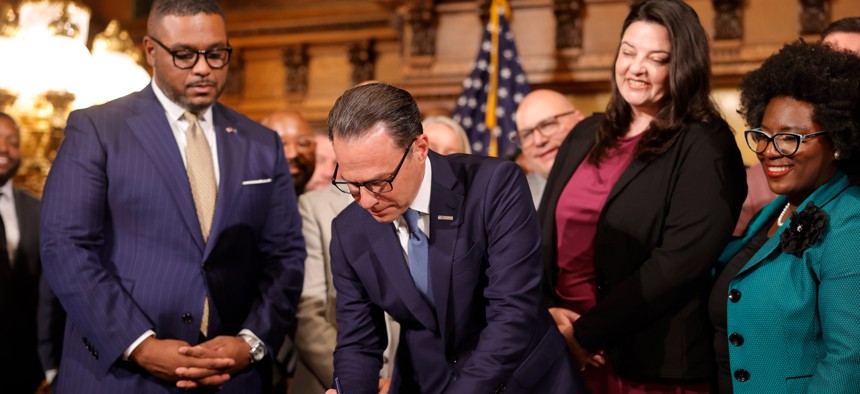
Gov. Josh Shapiro signs Pennsylvania’s 2026-27 state budget on July 12. Commonwealth Media Services

Pennsylvania officials avoided another lengthy budget impasse this year after Gov. Josh Shapiro signed a $50.8 billion state budget into law on July 12, following a flurry of weekend activity by state lawmakers. Democrats and Republicans alike framed the $50.8 billion deal as a product of compromise and divided government that had something for everybody: Shapiro said “there’s a lot in this budget that we can all be proud of,” while Senate Majority Leader Joe Pittman called it an "imperfectly good” budget.
“This is the fourth year in a row where – despite working with one of the only divided legislatures in the country, where we have some really profound differences – we stayed at the table and brought Democrats and Republicans together to get stuff done, again,” Shapiro said.
The budget includes wins for members of the state’s two biggest pension systems, a new tax credit program designed to fund grants to life sciences and biotechnology startups, and sizable investments in the state’s public schools. It’s also notable for what it doesn’t include: lawmakers were able to avoid transferring money out of the state’s Rainy Day Fund despite the state staring down a structural deficit, and the deal failed to include a regulatory framework for skill gaming machines, which the state Supreme Court recently ruled illegal, giving lawmakers a little over 100 days to find a legislative solution.
Below, City & State breaks down Pennsylvania’s 2026-27 state budget, highlighting 10 things you need to know about the $50.8 billion budget deal.
Increases in education funding
This year’s budget continued to invest in the state’s public schools, with several increases in education-related line items. The budget includes a $58 million increase for basic education funding, a $565 million increase in adequacy and equity supplements, a $55 million increase in special education funding and a $10 million increase in funding for career and technical education.
Cost-of-living adjustments for Pennsylvania pensioners
Certain members of the state’s two biggest pension systems – the Public School Employees’ Retirement System and the State Employees Retirement System – will soon receive a long-awaited cost-of-living adjustment. This year’s Fiscal Code legislation, Senate Bill 146, delivers COLAs to beneficiaries of both systems who retired before July 2, 2001. During his Sunday press conference, Shapiro said the adjustments could result in some beneficiaries receiving an extra $300 per month, or roughly $3,600 a year. He added that the adjustment for pension beneficiaries – which include teachers, police officers and firefighters – was a long time coming. “This is a problem I heard about when I was knocking on doors running for state Rep. in 2004 back in Abington,” the governor said. “So now (state Rep.) Ben Sanchez can go knock on doors and tell them we got it done.”
The Rainy Day Fund stays intact
Despite concerns earlier this year that Pennsylvania might have to draw on its Rainy Day Fund to balance the budget, the state avoided doing so – for the time being. Pittman credited higher-than-anticipated revenues for helping the state avoid drawing money from the Rainy Day Fund, which currently holds over $7 billion in reserves. “If you would have told me four months ago that we would have stayed out of the Rainy Day Fund because of the revenue growth that we have experienced over the last three months, I would not have believed you,” he said.
No deal on skill games
One of the hottest topics in Harrisburg has been so-called games of skill, the video gaming machines where winnings are based on an element of skill, rather than chance. The machines have found homes in bars, convenience stores, fraternal clubs, fire halls and other locations – and were recently ruled to be illegal gambling machines by the Pennsylvania Supreme Court. Shapiro had proposed taxing and regulating the machines in his 2026-27 executive budget proposal – a move his administration estimated would generate more than $2 billion annually if gross terminal revenues from the machines were taxed at 52%. However, despite the court giving lawmakers a little over 100 days to develop a legislative framework for the now-illegal gaming machines, Pennsylvania leaders ultimately did not address skill games in this year’s budget.
Reporting requirements for data centers
Data centers are all the rage right now – literally. With residents from across the commonwealth fighting back against data center proposals in their communities, this year’s budget includes language to require data center operators to report their annual water and electricity usage to the state. This year’s Fiscal Code requires data centers to submit annual reports to the state Department of Environmental Protection that outline the facility’s total energy consumption for the previous year, the average amount of energy usage per hour during the data center’s peak load and the facility’s total water consumption during the past year. Reports must also mention any measures that data center operators have taken to reduce energy consumption or water usage.
Mandatory recess
In a win for kids everywhere, the Public School Code bill approved as part of the 2026-27 state budget makes recess mandatory for students in kindergarten through fifth grade. The law requires schools to provide at least 30 minutes of recess during each school day, and at least 15 minutes of recess each day for students in half-day kindergarten. Shapiro said he was proud to secure that language in this year’s budget. “Common sense suggests kids need more time to play and socialize – and interact with one another,” he said.
Social media literacy
This year’s Public School Code, House Bill 1505, requires academic standards adopted by the State Board of Education to include social media literacy education. The law directs the board to consider recommendations made by the Joint State Government Commission’s Task Force on Child Protection in the Digital Age. The law also directs the state Department of Education to provide social media literacy materials to public and private schools.
The creation of the Innovate in PA 2.0 program
As part of his executive budget proposal, Shapiro pitched creating the Innovate in PA 2.0 program, funded through the sale of Insurance Premium Tax Credits. Under language in the state’s Fiscal Code, eligible insurance companies may purchase up to $125 million in tax credits, the proceeds of which will be used to fund grants to life sciences and biotechnology startups, workforce development partnerships and regional venture studios. “This budget makes $125 million available to provide capital for start-ups, fund clinical trials for the life sciences, and develop a workforce and education pipeline to help these companies succeed,” Shapiro said following the budget's passage.
Millions of dollars for state road repairs
In what is welcome news to anyone who drives on state roads, this year’s budget includes an additional $775 million – from the state’s Motor License Fund – to repair state roads over the next 18 months. That figure includes $500 million this fiscal year and $275 million next fiscal year, according to the Shapiro administration.
No new revenue sources
Finding new revenue sources dominated discussions surrounding this year’s budget. In addition to the $2 billion that the Shapiro administration suggested could come from a 52% tax on skill game revenue, Democrats in Harrisburg floated a range of policy changes designed to generate new revenue for the state. All of those proposals – legalizing recreational marijuana, raising the state’s minimum wage and taxing digital advertising platforms – were left out of this year’s budget, meaning the conversation around finding new sources of revenue will likely continue into next year’s budget cycle.