
Policy
City & State’s 2026-27 Pennsylvania state budget tracker
Gov. Josh Shapiro signed a $50.8 billion budget into law on July 12.
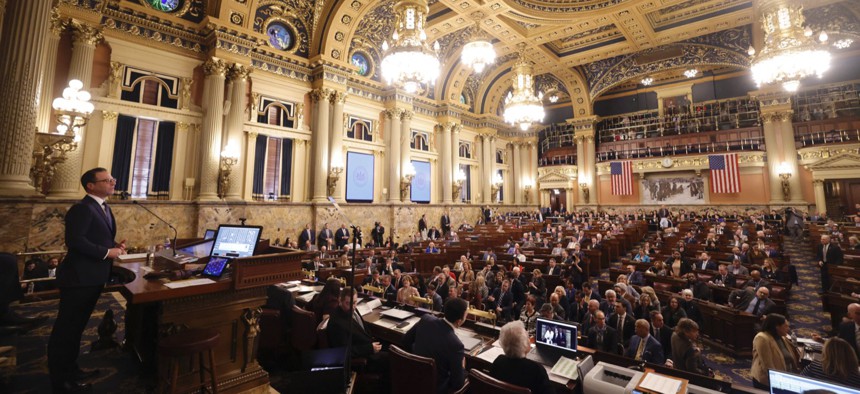
Gov. Josh Shapiro gives his fourth budget address in February 2026. Commonwealth Media Services

After last year’s budget impasse dragged on for more than 130 days, Pennsylvania lawmakers avoided a replay this year, approving a $50.8 billion budget package roughly two weeks after the state’s budget deadline. After Gov. Josh Shapiro presented lawmakers with a $53.3 billion spending plan in February, the General Assembly sent a $50.8 billion budget deal to his desk, which he signed into law on Sunday evening.
City & State has put together a budget tracker for the 2026-27 fiscal year, offering an up-to-date look at the state budget’s progress through the legislative process.
July 12, 2026: Shapiro signs $50.8B state budget after lawmakers return for weekend votes
In a flurry of weekend activity, lawmakers in the Pennsylvania House and Senate advanced a $50.8 billion state budget package that includes cost-of-living adjustments for certain beneficiaries of Pennsylvania’s two biggest pension systems, continued investments in the state’s public schools and a new tax credit program designed to fund grants to life sciences and biotechnology startups.
The budget does not levy any new taxes or draw from the state’s Rainy Day Fund – something lawmakers had worried could happen due to the state’s structural budget deficit. Notably, the budget package does not include a deal to tax and regulate skill game machines, which the Pennsylvania Supreme Court recently ruled are illegal gambling machines, giving state lawmakers 120 days to develop a regulatory framework for the now-illegal games.
Gov. Josh Shapiro signed the bill shortly after lawmakers sent it to his desk on Sunday.
“This is the fourth year in a row where – despite working with one of the only divided legislatures in the country, where we have some really profound differences – we stayed at the table and brought Democrats and Republicans together to get stuff done, again,” Shapiro said at a press conference Sunday evening where he signed the bill into law.
Shapiro highlighted the budget’s investments in education funding, the creation of a new Innovate in PA 2.0 tax credit program and hundreds of millions of dollars dedicated to repairing state roads, among other line items.
“I’m proud to say that if you go back and look at the goals we set way back in 2023 – funding our schools, making communities safer, growing our economy,” Shapiro added, “four years later, this budget reflects those priorities.”
Senate President Pro Tempore Kim Ward, the chamber’s top-ranking Republican, praised the budget package approved by lawmakers on Sunday. “I think that working together, making the compromises, making the hard choices, we have done a real service to those that we serve in this Commonwealth.” Senate Majority Leader Joe Pittman characterized the final product as an “imperfectly good budget.”
“Imperfectly good, but as we know, perfection should not be the enemy of good,” Pittman said.
Pittman added that higher-than-anticipated revenues helped the state avoid drawing money from the Rainy Day Fund. “If you would have told me four months ago that we would have stayed out of the Rainy Day Fund because of the revenue growth that we have experienced over the last three months, I would not have believed you,” he said.
Democratic state Sen. Nikil Saval said the budget did little to develop new revenue sources at a time when the state is experiencing rising costs. Saval said the budget defers “a serious revenue conversation around where and how we increase revenue for the things that we want to invest in and need to invest in in this Commonwealth.”
House Bill 2400, this year’s appropriations bill, ultimately passed the state Senate with a bipartisan 44-6 vote. The House passed the legislation with a 167-35 vote. Other budget-enacting bills in this year’s budget package include Senate Bill 146, a Fiscal Code Bill, and House Bill 1505, a Public School Code bill.
House Majority Leader Matt Bradford, a Democrat, celebrated the budget for providing COLAs to pension recipients and its investments in public education, describing the final product as “bipartisan” and “pro-growth.”
“The policies of this administration – and even with this divided government that sometimes is more dysfunctional than either of us would like – are paying dividends,” Bradford said Sunday on the House floor. “Pennsylvania is moving forward when other states are not. We need to double down on this.”
June 30, 2026: Lawmakers miss June 30 deadline; GOP leaders expect to pass budget ‘in the days following July 4th’
June 30 marks the end of the state’s fiscal year, and Pennsylvania officials concluded the day without advancing a finalized budget for the 2026-27 fiscal year. And while the state will once again miss its June 30 budget deadline, GOP leaders in the state Senate expressed optimism that a budget package will be advanced sooner rather than later.
In a joint statement, Senate President Pro Tempore Kim Ward, Senate Majority Leader Joe Pittman and Senate Appropriations Committee Chair Scott Martin said they expect a budget agreement to advance after the Fourth of July.
“This week, we have received the necessary clarity on many outstanding issues which were delaying completion of this year’s budget,” the Senate leadership team said in a statement. “Presently, we believe we are well on our way to effectuating a full budget agreement in the days following July 4th. At the conclusion of session today, the Senate will recess to the call of the President Pro Tempore and will reconvene once final budgetary language is ready to advance.”
Pittman, in remarks on the Senate floor, underscored his confidence that negotiations are in a good place.
“I actually think we’re in a very good position based on the conversations and the understandings that I’ve had over the last several hours,” he said, adding that the divided nature of the General Assembly will require compromise. “There will be difficult choices, there will be pain, there will be discomfort at all levels – but we will meet in the middle. We will conclude this process, I believe, in the next several days with a responsible product.”
In a press conference following Tuesday’s legislative session, House and Senate Democrats voiced frustration that the chamber recessed without passing a state budget.
On X, the Pennsylvania Senate Democratic Caucus accused Republicans of slow-walking a state budget. “Senate Republicans are purposely dragging their feet by ending session early and going home until next week,” the caucus said in a post. “Let’s get to work.”
June 22, 2026: Senate GOP leaders ‘encouraged’ by budget talks, call for fiscal responsibility
Acknowledging the difficulties of divided government in the Pennsylvania General Assembly, Senate Republican leaders said on June 22 that they are “encouraged” by ongoing budget negotiations and called for a fiscally responsible end product.
“While divided government naturally brings differing perspectives and objectives, it also creates an opportunity to find common ground and put the needs of Pennsylvanians first,” Senate President Pro Tempore Kim Ward, Senate Majority Leader Joe Pittman and Senate Appropriations Committee Chair Scott Martin said in a joint statement.
“Our Senate Republican Caucus priorities for this year continue to be that the final budget plan must be fiscally responsible, respect taxpayers, and position the Commonwealth for sustained growth,” the statement continued. “We are encouraged by the progress made to date and believe a budget agreement can come to fruition in the near future.”
June 12, 2026: Shapiro signs 9 appropriations bills into law
To date, Gov. Josh Shapiro has signed nine appropriations bills into law, funding government offices, entities and programs like the Pennsylvania State Police, the Pennsylvania Gaming Control Board, the state’s two largest pension systems, the Public Utility Commission and the state’s Workers Compensation system, among others.
After signing the appropriations bills into law on June 12, Shapiro said that by signing the appropriations bills, the state is “ensuring we continue to process licenses and certificates quickly, support our retirees, and fund the agencies who serve hardworking Pennsylvanians.”
Shapiro noted that negotiations on a final, negotiated state budget continue. “This is the first step toward a final budget, and we will continue to have productive conversations with the House and Senate to deliver for the Commonwealth,” he said.
May 6, 2026: PA Rep. Jordan Harris pressures PA Senate to act on budget legislation
Speaking during a House Appropriations Committee meeting on Wednesday, House Appropriations Committee Majority Chair Jordan Harris put pressure on the Republican-controlled state Senate to act on budget legislation, arguing that Pennsylvania can’t afford another late state budget.
Harris said it has been 22 days since the House passed legislation mirroring Gov. Josh Shapiro’s February budget pitch, and cautioned that a late state budget could jeopardize funding for school districts and nonprofits.
“We cannot afford what we had last year, where our budget was more than 135 days late,” Harris said. “The State Senate does not have to agree with what we sent them, but they have to do something. If they don’t agree with what we sent, that’s fine. They could send us their own proposal. Our main focus remains clear: delivering a responsible, balanced and on time budget that invests in Pennsylvania’s education, supports our law enforcement, strengthens Pennsylvania’s economy and returns money back into the pockets of our working families.”
April 14, 2026: House lawmakers pass budget bill
On Tuesday, April 14, House lawmakers passed a General Appropriations bill with bipartisan support, advancing the bill to the Senate in a move that could make it easier to advance a negotiated state budget once Gov. Josh Shapiro’s administration and lawmakers agree on a final product closer to the state’s June 30 budget deadline. The legislation, House Bill 2400, was advanced by the state House with a 107-94 vote on April 14, with lawmakers on both sides of the aisle acknowledging that the bill’s passage is a first step in an ongoing budget process.
“Today’s passage of the proposed state budget is an important step in moving the General Appropriations bill process forward and keeping us on track to deliver an on-time budget for the people of Pennsylvania,” House Appropriations Committee Chair Jordan Harris said in a statement, noting that negotiations on the budget are ongoing. “This bill passed the House with bipartisan support, reflecting a shared commitment to moving this budget forward and getting a budget done on time.”
Following the House vote, Senate Republican leaders said they continue to have concerns about the level of spending in Shapiro’s proposal. “We continue to have profound concerns about the level of spending in the budget proposed by Governor Shapiro and passed by the House today,” Senate President Pro Tempore Kim Ward, Senate Majority Leader Joe Pittman and Senate Appropriations Committee Chair Scott Martin said in a joint statement.
“Moving a budget plan forward is an important step in the process, but much work remains to reach a final agreement which respects taxpayers both now and in the future,” the trio added. “We will continue to fight for a more fiscally responsible spending plan that better positions our Commonwealth to grow and prosper, without placing unreasonable financial burdens on Pennsylvania families and taxpayers.”
Feb. 3, 2026: Shapiro presents $53.3B budget proposal
Gov. Josh Shapiro presented his fourth executive budget proposal to state lawmakers Tuesday, Feb. 3 – a $53.3 billion spending plan that called for continued funding for education and law enforcement, reforms on issues such as housing and data center development, and renewed calls for new revenue sources, including recreational marijuana and skill gaming machines. Democrats in the General Assembly praised Shapiro’s budget proposal, with House Appropriations Committee Chair Jordan Harris calling it a budget “that works for Pennsylvania and protects Pennsylvania.” Republican leaders, however, said the level of spending in the budget was too high. “The governor simply wants to spend too much money in this budget, period. Full stop,” Senate Majority Leader Joe Pittman said following the governor’s budget address.
In the weeks following his budget speech, lawmakers in the state House and Senate held a series of appropriations hearings to gather more information on the spending levels and policy proposals in Shapiro’s budget pitch.