
Budget
Mayor Cherelle Parker’s long-term budget plans get go-ahead from state-appointed board
The Pennsylvania Intergovernmental Cooperation Authority unanimously approved the city’s five-year fiscal plan
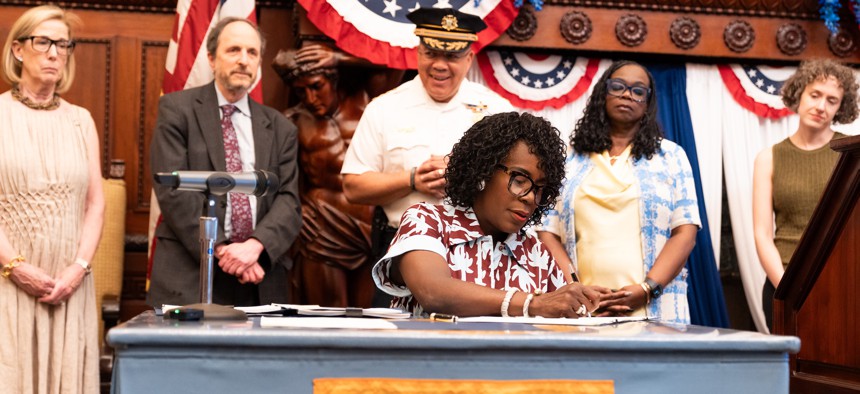
Mayor Cherelle Parker and her administration speak at budget press conference on June 11, 2025 City of Philadelphia // Photograph by Quinton Davis

A state-appointed board that oversees Philadelphia’s finances approved Mayor Cherelle Parker’s five-year budget plan on Tuesday, giving the go-ahead to the city’s near-term fiscal future.
The Pennsylvania Intergovernmental Cooperation Authority – a five-member board tasked with evaluating the city’s financial plans – unanimously approved the City of Philadelphia’s plan Tuesday afternoon after a brief back-and-forth between PICA board members and the Parker administration.
Tuesday’s approval, the final step in the city’s annual budgeting process, means state-controlled funds totaling roughly $1 billion will continue to flow to Philadelphia. The approval comes after Parker and City Council agreed to a $7.1 billion budget for the fiscal year that began on July 1, in addition to the five-year fiscal plan.
“The assumptions for revenues and spending were reasonable and consistent, and it also takes steps to avoid future fiscal crises,” Marisa Waxman, PICA executive director, said during the meeting. “The ongoing efforts to get the (city employee) pension fund to 100%, the deposits into the budget stabilization fund … and allocations to the labor reserve for those future union contracts” were all considered feathers in the city’s financial cap.
Financial projections estimate the city’s fiscal year 2027-2031 revenue growth rate at 2.5%, with spending growth at 0.5%. Those calculations would leave the city with more than $107 million in its general fund balance in fiscal year 2031 – and a stabilization reserve balance of more than $350 million. As of this year, with the city still relying on reserves and an existing surplus to plug an operating deficit, the city will have an estimated $364.6 million fund balance.
PICA’s executive summary noted both positive outlooks and potential risks, approving of the city’s commitment to maintaining pension plan funding and stable credit ratings as well as budget stabilization reserves and labor reserves. More concerning, however, is ongoing uncertainty both within and outside of the city’s policy decisions.
Despite the board’s approval, the executive summary also identified fiscal risks for the city, including external funding and policy uncertainty, labor needs and costs, and the expansion of programs without recurring revenue sources and/or standard reporting. The PICA report noted that, should the city see a significant shift in its federal funding allocations – which came in at about $2.2 billion in fiscal year 2024 – “will not be able to absorb federal funding reductions at a greater scale without significant service reductions.”
“We have more in the labor reserve than we’ve ever had before,” Rob Dubow, the city’s director of finance, said during the meeting, noting that the city has set aside $600 million for future collective bargaining negotiations with labor unions. “We’re trying to do things to give ourselves a little bit of a cushion.”
Dubow said the city is on track to unlock hundreds of millions of dollars in additional revenue once its pension fund is fully funded, a major milestone that is projected to take place in fiscal year 2033.
PICA recommended policy changes to address operating deficits that persist for city programs through fiscal year 2030. It’s for that reason, PICA noted, that the city’s total reserves as a percent of revenue fall below recommended levels in all years of the plan.
In other words, the city anticipates spending to outpace revenues through 2030, but that gap is projected to shrink over time – and an operating surplus is expected in 2031.
PICA’s past and future
PICA was established in 1991 to oversee the City of Philadelphia’s finances, with an ability to borrow funds on behalf of the city. PICA also requires the city to submit annual five-year financial plans for approval by its board.
The board’s establishment, which came during a severe financial crisis for the city, was enacted through the Pennsylvania Intergovernmental Cooperation Authority Act for Cities of the First Class, or the PICA Act, to assist the city with a growing operational deficit, mounting debt and credit ratings which were dropping below investment grade.
The state-appointed board consists of five voting members chosen by the governor, president pro tempore of the Senate, minority leader of the Senate, speaker of the House and minority leader of the House. The board also appoints a staff to execute the functions of the authority. Using the state’s credit rating, PICA has previously issued bonds that provided needed funds for the city budget that would be paid back using the city’s wage tax.
The city finished paying off its PICA-issued bonds in 2023, but city and state leaders still seem to value PICA’s oversight and the impact it has on City Hall’s financial practices. PICA’s perceived value was reassured a year prior, when, in 2022, then-Gov. Tom Wolf signed legislation extending PICA’s authority to 2047, or until all outstanding debts and/or liabilities of PICA have been fully discharged.
PICA has helped reform the city’s pension system and employee health system, and establish a Rainy Day Fund that was utilized during the COVID pandemic. It continues to be charged with maintaining the city’s financial stability through the review and approval of annual five-year plans.
PICA approved Parker’s budget last year after its staff expressed concerns about the city’s increasing reliance on debt-financing and federal funding cuts aimed at cities.
At the start of the meeting, Kevin Vaughan, who has served as chair of the board for roughly a decade, announced that while he will remain on the board, he will not be seeking reelection to the lead administrative position. Vaughan has an extensive career in government service including time as executive director of the Philadelphia Commission on Human Relations, regional director of the U.S. Department of Health and Human Services and several other positions within city government.
In his place, Alan Kessler, an attorney and PICA board member since 2015, will take over as chair of the board.