

News & Politics
$10B in investments, the evolving nature of war – and other takeaways from Dave McCormick’s 2026 defense summit
The two-day summit was headlined by an appearance from President Donald Trump.
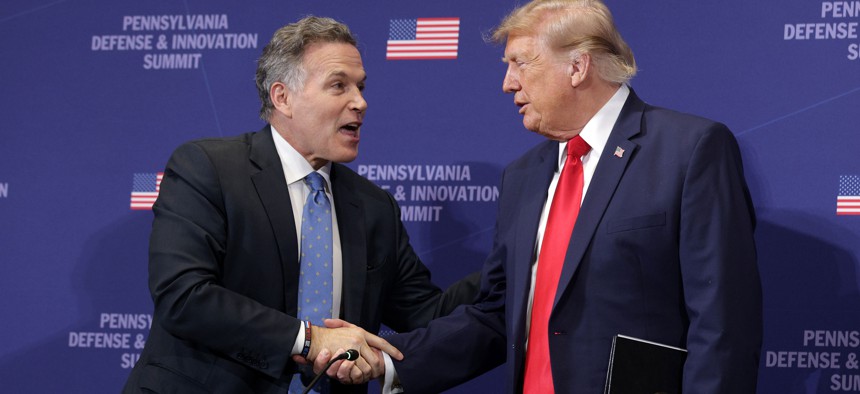
U.S. Sen. Dave McCormick speaks with President Donald Trump at the 2026 Pennsylvania Defense and Innovation Summit. Alex Wong/Getty Images

This week, U.S. Sen. Dave McCormick convened leaders from across the public and private sectors at the U.S. Army War College in Carlisle for a two-day summit that showcased the evolving nature of defense, warfare and national security – and featured an appearance from President Donald Trump.
At the Pennsylvania Defense and Innovation Summit, McCormick announced $10 billion in investments in Pennsylvania that will create 4,000 jobs, while also championing Trump’s $1.5 trillion defense budget request. Trump closed out the two-day summit with a roundtable discussion that also featured Secretary of War Pete Hegseth, Army Secretary Dan Driscoll, McCormick and a host of business leaders.
McCormick’s summit was attended by other high-profile government leaders, including Gov. Josh Shapiro, U.S. Rep. Scott Perry, Joint Chiefs of Staff Chairman Dan Caine and CIA Director John Ratcliffe, as well as companies active in the defense and tech spaces, such as Northrop Grumman, Lockheed Martin, Blackstone and Palantir Technologies.
“Achieving President Trump’s vision of peace through strength demands new players and new ways of doing business, and Pennsylvania can show the way,” McCormick said on Wednesday.
Trump and McCormick celebrate $10 billion in Pennsylvania investments
This year’s summit came one year after McCormick announced $90 billion in AI- and energy-related investments in Pittsburgh last July. McCormick followed that up this year with news of nearly $10 billion in defense-related investments that he said will support more than 4,000 jobs across the state.
“Pennsylvania has powered American defense since the Army, Navy, and Marine Corps were founded in Philadelphia in 1775. That legacy carried us through the Arsenal of Democracy in World War II, and it's carrying us today through advanced manufacturing, robotics, AI, and space,” McCormick said in a statement announcing the investments. “President Trump has laid out a bold vision for American strength, and Pennsylvania is proving it can deliver, bringing the innovation, the workforce, and the will to build it.”
In Philadelphia, Rhoads Industries and General Dynamics will benefit from a 10-year, $2.5 billion strategic agreement aimed at boosting advanced manufacturing and shipbuilding for U.S. Navy submarine construction at the Philadelphia Navy Yard. The agreement will reportedly support 1,350 jobs through 2035. Additionally, Hanwha Group is receiving new ship orders from the Department of Transportation’s Maritime Administration valued at $1.5 billion, which will result in more than 2,000 jobs. JP Morgan Chase also committed close to $25 million to bolster shipbuilding and maritime manufacturing in Philadelphia – an investment that will create 450 permanent jobs.
In Pittsburgh, Eos Energy Enterprises was awarded a Golden Dome for America contract to integrate long-duration energy storage, while Qintel, a cyber intelligence company, announced an $84 million contract with U.S. Cyber Command to build on its work with U.S. government agencies.
In other parts of the state, Mack Defense in Allentown will receive a U.S. Army order for 115 heavy dump trucks for the Army National Guard; and Kratos Defense in York announced plans to open a 167,000-square-foot advanced manufacturing facility in York and to purchase new equipment totaling $7 million. In the state’s northwest corner, Sphere Brake Defense in Erie will receive a $4.5 million U.S. Marine Corps contract for sphere brake kits for the Marine Corps’ amphibious combat vehicle fleet.
Pennsylvania universities will also benefit, with Penn State, the University of Pittsburgh and Carnegie Mellon University all announcing new agreements and initiatives.
Upon his arrival at the U.S. Army War College, Trump celebrated the investments, calling Pennsylvania a “hot place.”
“Pennsylvania workers will build the ships, submarines, trucks, weapons and industries that will ensure America remains the strongest and most powerful nation in the history of the world,” he said.
Trump said the investments announced Wednesday will bring good things to Philadelphia and Pittsburgh, among other locations.
“We’ll be building two massive national security multi-mission vessels at the beautiful and historic Philadelphia shipyard,” he said. “Eos in Pittsburgh just agreed to a multimillion-dollar partnership with the Department of War to build energy storage technology in support of our Golden Dome missile defense system. We’re building a Golden Dome over our country – and it’s going to be a very effective one.”
Pennsylvania’s role in national defense
One of the many discussions held throughout the two-day event focused on Pennsylvania’s role in defense and national security. In a panel discussion led by Pennsylvania State University President Neeli Bendapudi, McCormick joined forces with Gov. Josh Shapiro, Hanwha Defense USA President and CEO Michael Coulter and General Dynamics President Danny Deep to examine Pennsylvania’s contributions to the defense landscape.
McCormick noted that Pennsylvania is home to 9,000 defense-related companies that employ nearly 200,000 people. “Pennsylvania has always been at the center of our national defense,” the senator said. “The Carlisle arsenal here supported George Washington’s army. The hallowed fields of Gettysburg are where America, in many ways, went through its toughest chapter … We’re entering a new phase of enormous innovation in defense, and Pennsylvania should be, and in many ways is, the point of the spear.
“We have 190,000 employees, we have 9,000 defense-related companies, but even as important as that is, we also are on the cutting edge of innovation: drones, AI, autonomy, robots,” McCormick added. “That’s where the future is headed in terms of what our military capabilities need to be.”
Shapiro, who last year attended McCormick’s AI summit in Pittsburgh, said innovation in AI and technology are directly tied to the growth of the defense sector in Pennsylvania – and the health of the commonwealth’s economy as a whole. In response to a question from Bendapudi, Shapiro said that continued collaboration between academia, the defense sector and AI and tech companies is crucial.
“I think we are uniquely poised to grow the defense industrial base, in part because of you and leaders like you in academia, in part because of some of our traditional defense companies, but in large measure also because of a lot of what we talked about last year – our AI companies, our tech companies,” Shapiro said. “Figuring out how to bring all of that together is going to make our nation more secure, make Pennsylvania more prosperous, and continue to have us as a leader in this space.”
Coulter said that Philadelphia has long been home to shipbuilding in the United States, and that Hanwha has invested more than $200 million into its Philadelphia operations – and doubled its workforce – in an effort to “make shipbuilding great again.”
Deep added that General Dynamics, which produces ammunition at the Scranton Army Ammunition Plant, has more than 2,200 employees across eight operations in the commonwealth. He said the plant increased its artillery production from 14,000 to 50,000 rounds per month in the wake of the war in Ukraine. That was made possible thanks to partnerships between the public and private sectors.
Later in the day, the commonwealth also earned praise from Jon Gray, the president and COO of Blackstone Group, who lauded the state’s efforts to speed up permitting for various projects.
“This is a state that works. This is a state where people say, on a bipartisan basis, we want to see things get done, get built – and that’s why you're seeing so much economic activity,” Gray said.
Military and intelligence leaders talk evolving nature of warfare
Outside of the auditorium that hosted the day’s discussions on defense, more than 100 exhibitors – ranging from defense contractors and universities to weapons and technology manufacturers – lined the trade show area inside the U.S. Army War College. The participants put on full display the evolving nature of warfare and defense, with drones, robots and ammunition a common sight throughout the facility.
That message was echoed by the nation’s top military and intelligence officials, including Dan Caine, the chairman of the Joint Chiefs of Staff, and John Ratcliffe, the director of the CIA.
“Warfare is no longer confined to traditional domains,” Caine said during his keynote address on the summit’s first day. “It now stretches literally from the seabed to cislunar space, and soon, beyond. We’re fighting and competing in the cognitive space, the physical space, the cyberspace, and the information space, and it ranges from feeds on our phones to satellites and everything else – all at the same time.”
“At the same time, the very character of war is changing, driven by unprecedented complexity and technological acceleration in areas like AI, quantum autonomy and drones,” Caine added.
Ratcliffe, who served as the U.S. director of national intelligence during Trump’s first term, said that U.S. intelligence agencies are grappling with the same types of challenges as their military counterparts.
“The CIA’s future as an intelligence service – and, I would say more broadly, our future as a nation – depends on the CIA’s ability to adopt, adapt and deploy emerging technologies, both offensively and defensively, better than our adversaries,” he said, “to continue to give our policymakers the strategic advantage that they need for our continued success.”