
Donald Trump
One year later, PA’s congressional delegation is still split on the Big Beautiful Bill
President Donald Trump’s signature domestic policy bill continues to polarize members of Congress.
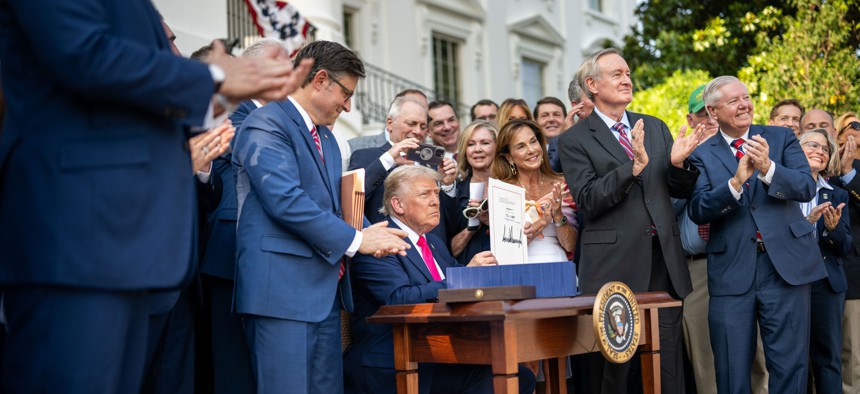
President Donald Trump signs the One Big Beautiful Bill Act into law on July 4, 2025. Wikimedia Commons

A year after President Donald Trump signed his sweeping domestic policy bill – the One Big Beautiful Bill Act – into law, members of Pennsylvania’s congressional delegation are still at odds over whether Trump’s signature tax law will do more to help – or hurt – Pennsylvanians.
The megabill made several expiring provisions in the 2017 Tax Cuts and Jobs Act permanent, and delivered on a key campaign promise of Trump’s by creating tax deductions for tips and overtime pay. The One Big Beautiful Bill Act also made significant changes to Medicaid spending and the Affordable Care Act, which critics feared would jeopardize insurance coverage for hundreds of thousands of Pennsylvanian residents.
With the law now on the books for one calendar year, Democrats and Republicans are pushing different messages about what the legacy of the One Big Beautiful Bill Act will look like.
Allies of the president, like U.S. Rep. Mike Kelly, said ahead of the law’s one-year anniversary that the bill – which he referred to not by the president’s own moniker but instead as the “Working Families Tax Cuts” – “leverages the tax code to work for Americans, not against them.”
“In its first year, the Working Families Tax Cuts put more money back into the pockets of hardworking Pennsylvania families, made historic investments in our nation’s children, gave a boost to our seniors, and strengthened Main Street businesses for years to come,” Kelly said in a statement.
Citing data from the U.S. Treasury Department, Kelly said 96% of filers who received a tax cut this year earned less than $200,000. He also noted that more than 7.5 million filers claimed the tip deduction, and another 29 million claimed the tax deduction for overtime pay.
“From employers to employees, from children to seniors, the Working Families Tax Cuts are a game-changer for Pennsylvanians,” he added.
Democrats sought to paint the bill in a different light, citing estimates showing more than 300,000 Pennsylvanians would lose health insurance coverage as a result of the bill. Nationwide, the nonpartisan Congressional Budget Office estimated that 10.5 million people would lose access to their Medicaid coverage under the One Big Beautiful Bill Act.
U.S. Rep. Brendan Boyle, in a media availability on Wednesday, said the bill slashed taxes for the country’s highest earners at the expense of funding for healthcare and food assistance.
“At its essence, you have the largest tax cuts for billionaires in American history – over $5 trillion’s worth – paid for by the deepest cuts to healthcare and food assistance in American history,” Boyle said. “This bill truly was Robin Hood in reverse. It is robbing from the poor, taking away their health care, taking away their food assistance, in order to give money to the ultra- and mega-wealthy.”
Boyle suggested that the damage from the One Big Beautiful Bill Act “is even worse” than the initial predictions indicated, claiming that 8 million Americans have already lost their health care coverage as a result of that bill and that another 8 million people could lose Medicaid coverage this December. That warning comes on the heels of anticipated premium hikes among insurers in the Affordable Care Act insurance marketplace, with the median proposed premium increase for 2027 at 14%, according to KFF, a healthcare research nonprofit.
Boyle was joined by nonprofit leaders and several current Medicaid recipients who voiced their concerns about losing their coverage.
James Luby, a Northeastern Pennsylvania resident who currently works as a stagehand, said that Medicaid helps him manage hypertension and autism, and that losing access to Medicaid coverage would be devastating.
“I don’t work to get Medicaid. I have Medicaid so that I can work. I’ve been everything from a movie producer to a taxi driver … since the pandemic I’ve been working as a stagehand – and I love my job,” Luby said. “If I were to lose Medicaid, I would be devastated, because I’d have no other option.”
Despite the tax law changes in the One Big Beautiful Bill Act, Pennsylvanians remain concerned about their personal finances.
According to a June poll from Franklin & Marshall College, 24% of voters listed the economy and finances as the most important problem facing Pennsylvania. Government and politicians came in second at 14%, and another 12% of respondents listed taxes as their chief concern.
Of the poll’s 546 respondents, 47% of those surveyed said they felt “worse off” financially than they did the year before, 40% said they felt “about the same,” and 14% said they felt better off.