
News & Politics
PA’s lack of contribution limits has led to a ‘Wild West’ of campaign fundraising
Pennsylvania has no limits on how much money can be donated to political campaigns – and there doesn’t seem to be much appetite to provide a fix.
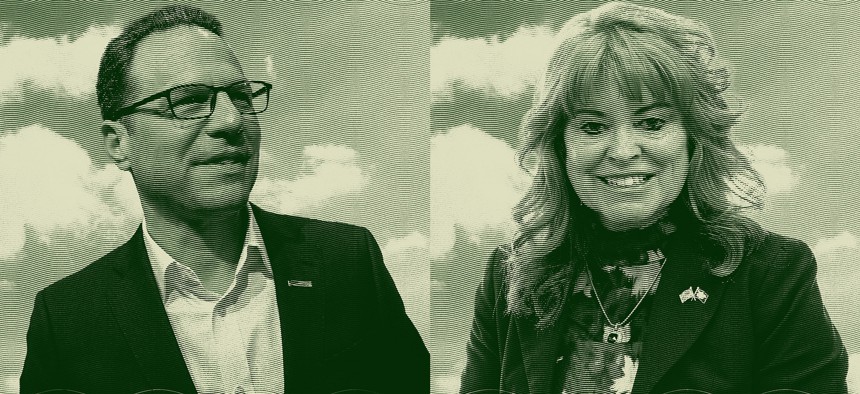
Tens of millions of dollars have already poured into this year’s gubernatorial race. MATTHEW HATCHER/GETTY IMAGES; Commonwealth Media Services; YOSUKE HASEGAWA/GETTY IMAGES

Wealthy donors and fat checks are nothing new in American politics. Each election cycle, those looking to influence elections and curry favor with politicians cut checks to candidates and political action committees, seeking to exert what influence they can on the nation’s political system.
Among both those seeking and those delivering those cash infusions, Pennsylvania stands out. The commonwealth has earned a “Wild West” reputation for its complete lack of contribution limits, which allows limitless spending and millions of dollars to regularly infiltrate elections.
That stands in stark contrast to limits on federal elections, where individuals are capped at $3,500 per year for contributions to individual candidates and $5,000 per year for contributions to political action committees.
“Campaign financing is nuts in Pennsylvania,” Rabbi Michael Pollack, the executive director of the government reform group March on Harrisburg, told City & State in an interview. “It's absolutely unlimited. You can give anything you want to anybody's campaign without limit. That's absolutely insane.”
Throughout its 10-year existence, March on Harrisburg has pushed for reforms to how money and perks permeate Pennsylvania politics – from gifts given to sitting lawmakers to the commonwealth’s virtually limitless campaign finance system.
The impact of Pennsylvania’s lack of contribution limits is on full display in this year’s elections for governor and state legislative seats in the General Assembly – as well as in recent retention elections for seats on the Pennsylvania Supreme Court.
In this year’s gubernatorial race, where incumbent Democratic Gov. Josh Shapiro is facing a challenge from GOP Treasurer Stacy Garrity, Shapiro has raised more than $50 million this election cycle, entering the summer with $38 million in cash on hand. That dwarfs sums raised by other governors running for reelection this year, like Arkansas GOP Gov. Sarah Huckabee Sanders, who has raised a little over $7.5 million in the current cycle, and Arizona’s Democratic Gov. Katie Hobbs, who has raised more than $4.5 million in 2026. Texas Gov. Greg Abbott rivals Shapiro in fundraising, having brought in over $28 million in the first six months of the year, bringing his total cash on hand to $67 million.
Shapiro’s $38 million war chest has been buttressed by a number of six-figure donations from his political allies – trial lawyers, labor unions and even the owner of the Philadelphia Phillies. Garrity has raised significantly less than Shapiro – reporting $1.48 million in total contributions in 2025 and raising $1.96 million through the first six months of 2026.
In 2026, there have already been several contributions to high-ranking Pennsylvania politicians that have broken the seven-figure mark. Earlier this year, Shapiro pulled in a $1 million contribution from business executive and investor Chris Larsen. In March, state Senate President Pro Tempore Kim Ward received a $2 million contribution in March from the Jeffrey Yass-backed Students First PAC.
And then there’s Yass himself.
Yass, a trader and co-founder of Susquehanna International Group, is Pennsylvania’s richest man and a prolific political donor who has funneled millions of dollars to conservative causes and candidates. An avowed supporter of school choice, he has donated more than $60 million to the Students First PAC, which, since 2022, has contributed money to several other political action committees.
Labor unions have traditionally been major spenders in the state’s elections, as well. According to an analysis from the Commonwealth Foundation, a Harrisburg-based conservative think tank, PACs connected to labor unions spent more than $22.4 million – a figure that includes contributions and in-kind, non-monetary donations – in the 2025 election cycle. Of that figure, $2.2 million went toward the state’s Supreme Court retention elections.
The tens of millions of dollars directed to candidates and political committees don’t even take into account the millions more spent on independent expenditures – the political communications that, thanks to the U.S. Supreme Court’s 2010 Citizens United v. FEC decision, aren’t subject to any contribution limits.
And while Pennsylvania candidates on both sides of the aisle play by the existing rules, there have been efforts in the state Capitol to reform the state’s campaign finance system by establishing a new framework for financing elections in the commonwealth.
In the Pennsylvania Senate, Minority Leader Jay Costa has routinely introduced sweeping legislation that would institute donation and expenditure limits in Pennsylvania elections, implement more stringent disclosure requirements for political campaigns and seek to limit foreign corporations from influencing elections in the commonwealth. Costa has introduced his omnibus campaign finance reform bill several legislative sessions in a row, though the bill has failed to receive consideration in the Senate.
“It's just frustrating that we cannot get a fair conversation on this,” he told City & State in an interview. “We are an outlier among states in that we don't have any limitations on what we can do with respect to contributions.”
Costa added that several Pennsylvania cities and municipalities – including Philadelphia, Pittsburgh and Allegheny County – have even placed limits on local elections, all while Pennsylvania continues to allow limitless wealth to flow into political contests.
“It's just crazy what folks can contribute, and how wealthy people can get into this game and keep people out of it because they don't have the resources necessary to compete,” he said.
Costa acknowledged that, as the leader of Senate Democrats and a key force in trying to elect more Democrats to the General Assembly’s upper chamber, Pennsylvania’s current campaign finance system requires him to play by the existing rules.
“The seat I sit in now requires me to participate under the rules that are in place – and I can't unilaterally disarm as much as I'd like to,” he said. “It's an injustice to my caucus if I do that, because I'm competing with the other side … The sooner we get something done, the better.”
In the state House of Representatives, lawmakers recently approved House Bill 497, which would prohibit foreign-influenced corporations from making political contributions to candidates, PACs, and political parties, and also bar such corporations from spending money on efforts to influence ballot questions.
Under the bill, foreign-influenced corporations refer to corporations where a single foreign investor holds, owns, controls or has beneficial ownership of 1% or more of the total equity, and those with two or more foreign investors that have beneficial ownership of 5% or more of the total equity, outstanding voting shares, membership units or other applicable ownership interests of the corporation.
“House Bill 497 simply says that there shouldn't be foreign influence in the elections, referendums, and government processes of Pennsylvania,” Democratic state Rep. Joe Webster, the prime sponsor of the bill, said on the House floor in June. “We need to protect Pennsylvanians from the fact that lots of money comes into our elections and we don't know where it's coming from. It's time to make sure we do know, and make sure it's in the best interests of Pennsylvanians.”
Pollack said the bill could significantly curtail the amount of corporate money flowing into Pennsylvania elections by limiting multinational companies' ability to contribute. “It takes out 98% of the S&P 500, which are multinational, technically foreign-influenced corporations,” he said.
Pollack noted that similar efforts in other states have faced legal challenges, including in Minnesota, where a judge blocked a similar law from taking effect in February 2025.
Republicans in the General Assembly have introduced campaign finance reform proposals of their own. State Sen. Lisa Baker is the prime sponsor of Senate Bill 105, which would require those making independent expenditures to disclose their top five contributors during that election cycle. In a co-sponsorship memo sent to colleagues, Baker wrote that such a requirement written into state law would “make it easier for citizens to ascertain who is donating the most money to generically-named PACs.”
Others have looked to change how unions use union dues for political purposes. David Osborne, the director of labor policy at the Commonwealth Foundation, pointed to “paycheck protection” proposals that would prevent union dues from being used for independent expenditures and political purposes.
“Unions have increasingly relied more on membership dues dollars because they can take an unlimited amount of union dues dollars and spend it in support of political candidates and causes,” Osborne told City & State in an interview. “These are independent expenditures that cannot be coordinated with proper campaigns, but that is where the bulk of the spending is going.”
A paycheck protection law, he said, would prevent that from happening “so that unions couldn't request the employer to deduct union dues or fees out of people's paychecks.”
Different sides of the political spectrum propose different solutions for curtailing the flow of money into state and national politics. But across the nation, there appears to be bipartisan agreement that too much money is devoted to politics.
A Politico poll released earlier this year found that 72% of Americans agree that there is too much money in American politics. That includes 80% of voters who chose former Vice President Kamala Harris in the 2024 presidential election and 77% of voters who cast their ballot for President Donald Trump.
The bipartisan agreement on the amount of money in politics also comes at a time when trust in U.S. institutions is at an all-time low, and Costa said reforms that address the unfettered flow of money in Pennsylvania elections could help in improving the public’s perception of their institutions.
“For the sake of the public's perception of the electoral process, I certainly would want to see more disclosure of people who are contributing – and limiting the amount that they're contributing,” he said. “Right now people feel that we’re the Wild West, and we can do what we want, when we want.”