
Interviews & Profiles
A Q&A with U.S. Rep. Scott Perry
The GOP congressman talks with City & State about Flock cameras, banning congressional stock trading and the 2026 midterm elections.
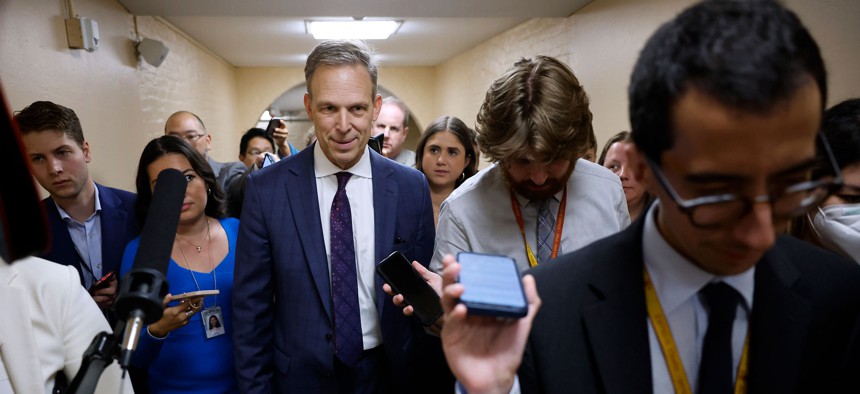
CHIP SOMODEVILLA/GETTY IMAGES

U.S. Rep. Scott Perry has made a name for himself as one of the most vocal conservatives in Congress. The former chair of the House Freedom Caucus and a longtime election-denier, Perry can still be found at the center of a number of political flashpoints.
He’s been an outspoken critic of Flock cameras, has pushed for legislation that would ban members of Congress from trading stocks, and is gearing up to once again face Janelle Stelson, a former news anchor who secured the Democratic nomination in Pennsylvania’s 10th Congressional District, in November. Perry recently spoke with City & State about his top priorities in Congress, as well as what Republicans need to do to succeed in the midterms.
The following conversation has been edited and condensed for length and clarity.
You’ve been publicly expressing concerns with Flock cameras. What are your chief concerns with them?
Most people are unaware of them. It’s warrantless surveillance by almost anybody. If you’ve got the money and the connection, you can purchase the data, and I don’t think that most people are aware of how prolific the cameras are and that they’re being surveilled. There’s really almost no policy regarding the use of that information for legitimate purposes, by legitimate organizations or individuals or otherwise – including United States adversaries like China or Russia or North Korea or hackers from Iran. There’s literally nothing that prevents almost anybody on the planet from having and utilizing this information in whatever way they want to. That’s the concern. It does have a legitimate law enforcement component, but there has to be a balance because we are all protected by the Constitution. But the Constitution doesn’t jump out of the frame and run to your aid; somebody has to use it to protect themselves. Again, if you’re not even aware that your rights are being violated, you don’t know that you need the protection.
You sponsored an amendment regarding Flock use on federal highways. What can be done at the congressional level to allay privacy concerns – while also allowing law enforcement to use that tool?
I think the first thing to do is have a conversation with concerned and interested parties, including law enforcement, which is what we’ve endeavored to do because we do want to make sure that we strike that balance. We think it is an important and useful technology; we want to see it used in the correct way, not used for nefarious purposes. The first thing is to have a conversation and understand the viewpoints of all the stakeholders – and then see where you can go from there. As a federal legislator, you want to make sure that abuses aren’t taking place, but that utilization for legitimate purposes is also a reality
The other thing is to raise awareness for citizens, and state and local lawmakers. The advent of these things and the proliferation of them is relatively new – within the last couple years. Most citizens just aren’t even aware. That’s part of the conversation – just making sure that people are aware of their surroundings and what’s happening.
You recently voted in support of a congressional stock trading ban. What is your take on this issue?
I have been the prime sponsor, co-sponsor, original co-sponsor of numerous of these types of bills, most of them bipartisan; this is the latest iteration. Just like almost anything else, there’s always somebody that abuses the goodwill of the organization, of the people.
People run for office because they say they want to serve, but the reality is, in some cases, they’re serving themselves. Most people don’t start a job where they can get information that other people don’t get, where they’re making a decent salary, but not becoming wealthy.
Statistically, the numbers show that some of these people with access to information outperform everybody else, including people who watch markets and do financial advice for a living. I like to say that serving isn’t about what you can get; it’s about what you can give. If you want to go make millions of dollars in the stock market, well, God bless you – do that for a living. But if you’re trying to do that at the same time you’re supposed to be looking out for the well-being of your constituents – your bosses – it sure doesn’t look that way when you’re getting rich and they’re not.
Speaking of insider trading, that’s also becoming an issue with prediction markets. Do you think that’s something that needs to be curbed through legislation?
We live in America, and people are generally supposed to be free to do what they want to do. But when you agree to serve, when you take on one of these roles as a servant, I think that there’s a sacrifice that comes with service. And if you’re not willing to do that, then you should do something else. I think that as time goes on, we’re probably going to have to address those issues in the same way that we considered insider trading and the stock ban for members of the legislature.
All that kind of activity has a corrosive effect on the trust that people have in institutions. That’s not sustainable, and it is not healthy. It’s not everybody that does this, but there always seems to be someone that abuses it – and so, because of that, then you’re forced to take action.
What else is at the top of your agenda?
Our energy prices are way too high. Some of it is market-based, but a lot of it is policy-based, where we choose to force our consumers – our citizens – to buy the least efficient, most expensive power on the planet. This is not something that just showed up. This has been going on for some time in Pennsylvania. In the last 11 years, we’ve shut down nearly five gigawatts of baseload power that is traditionally fueled, and the cost of that is reflected in everybody’s bills. People have a hard time making all this stuff add up to their paychecks. So the cost of energy is something that I have worked on continuously this session.
The cost of healthcare probably will be an issue in this campaign. One of my frustrations is that the folks that actually caused the problem are going to blame the problem on the folks that had nothing to do with it. That’s particularly the Affordable Care Act or Obamacare. Prices have gone up fantastically since that legislation has been enshrined in law. People can’t afford it. There are long wait times, and somehow the Democrat Party now seeks to blame the Republican Party for what they did – and not one Republican voted for it.
Another focus is just privacy in general regarding the federal government. The fact that we cannot get the Senate to agree to put a ban on a central bank digital currency concerns me. When you tie that with artificial intelligence, gait analysis, facial recognition software, automatic license plate readers like Flock – and then put the power of the federal government to determine what you buy and if you’re allowed to buy it – those are things that, to me, are of great concern. We want to make sure that everybody’s constitutional rights are upheld and respected.
The midterms can be challenging for the party that controls the White House and Congress. What do you think Republicans need to do to avoid losing seats?
Well, whether you’re Republican or Democrat, the job is to go out and earn it every day, and not act like just because you’re there, you’re somehow anointed to be there. You have to show your bosses – the people that you’re working for – that you’re working for them, that your focus is on them, that your service is to them and is respectful of them. They know that you’re not going to agree on every single thing. I’ve got 760,000 bosses that span from the rural farmlands of central Cumberland, York, and northern Dauphin County to the city of Harrisburg and the city of York and Carlisle. You’re not going to be able to please everybody on every single occasion, but you’ve got to be respectful of their viewpoints and show them that you hear them, and that you’re trying to improve their lot in life. That means sometimes standing against your own party when necessary. I don’t think there’s one representative in Pennsylvania that – on either side of the aisle – can claim that more than I can.
I think we have to inspire our voters, regardless of where they are politically. Especially now, where it’s a choice between normal and absolutely crazy. When you look at the so-called Democrat Socialists that have taken over what used to be the Democrat Party – they want to get rid of prisons, they want to get rid of the police. They literally say that. It’s not me saying that. They say that they want to get rid of the United States Senate. They want a wide-open border. Most people just want to live in a world that’s normal, where their girls shower and play sports with other girls, where the criminals go to jail instead of getting access to your home, and then you’re questioned for trying to defend yourself. I think that Republicans in general need to remind everybody how crazy the Democrat Party has now become. It’s been taken over by these absolutely radical viewpoints that are antithetical to the American way of life. But it’s up to us to make that case.
When talking with PA-10 constituents, what are you hearing as their major concerns?
No matter what, everybody wants the government to be accountable. One of the things I hear is that all these things happened in the past administration, and no one’s really been held accountable. Voters are frustrated with that. The other thing I hear is: Does my vote matter at all with this ubiquitous mail-in ballot system where we send out thousands upon tens of thousands of ballots that are untracked, unknown? We don’t verify citizenship. We don’t verify whether you’re a resident. We don’t even verify whether you’re alive. And does my vote even matter? We used to be able to know the night of or, at the latest, the next day if somebody won an election. Now it takes maybe weeks to know. This is the 21st century; it seems like we’re headed in the wrong direction.
We all buy things and have to pay our bills; people are frustrated that costs continue to go up – and they want some relief. Even as the economy is doing much better than it did, even as lower-wage jobs are increasing in wages, and even as people’s retirement incomes increase through their 401(k) or their stock portfolio – they still demand lower prices. I certainly understand that; I’m paying the same prices, too. On all those fronts, I have answers to those folks. Some things I can do something about and I fight on, and some things I fight on but I don’t have as much horsepower. On things like voting, the states decide a whole lot of that, per the Constitution. Where we can, we have threaded the needle on the SAVE America Act. But again, while I have voted for it multiple times, the United States Senate seems reluctant to – and I’m not a United States senator, so all I can do is put it strategically in the best position for them to do that, and to urge them to do that. The point is to hear everybody’s concerns and to explain what you’ve done to address them.