
Interviews & Profiles
A Q&A with PA House Speaker Joanna McClinton
McClinton discusses the 2025-26 state budget, the CROWN Act and the need to address transit funding.
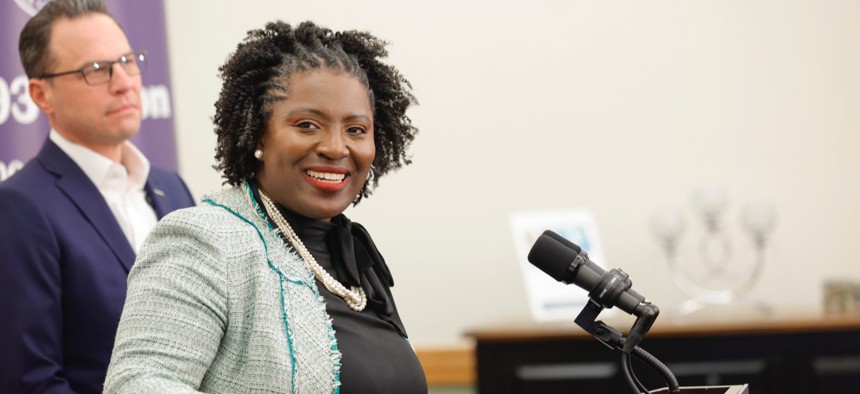
Speaker Joanna McClinton speaks at a November 2025 press conference in Harrisburg. Commonwealth Media Services

With the year coming to a close, House Speaker Joanna McClinton believes there are a lot of positives that came out of Harrisburg in 2025 – chief among them a new tax break that will help working families keep more money in their pockets.
In a sit-down interview with City & State, McClinton walked through the General Assembly’s most significant accomplishments of 2025, including tax relief for working Pennsylvanians, increased funding for public schools and a measure that aims to prevent discrimination across the commonwealth. She also previewed issues that could dominate discussions at the state Capitol over the next year.
The following conversation has been edited for length and clarity.
What are some of the wins you're particularly proud of this year?
So the big wins are inside the budget for me, starting with the Working Pennsylvania Tax Credit. We’re a state of just about 13 million people, and starting in January, almost 1 million of those people will be getting $800 back in addition to their federal Earned Income Tax Credit. It will really be significant for people who work very hard but don’t get paid tons of money. It’s going to really be a wonderful investment and down payment. For me, it’s a mark of pride I shared at a presser with the governor that, if my mother was still working, and if I was somehow under 18, she would qualify for this. It will help many neighbors in my district and many others across the commonwealth. It’s exciting because it’s the seventh time we’ve cut taxes since we’ve been in charge here in the state House. So that is really meaningful.
I think about last fall, October 2024. I was at a church in West Philly, and the woman who invited me to visit told everyone, “Because I worked where I worked and retired, I’ve never been able to get anything extra.” And of course, when you retire, the numbers look right, but as the years go by, your retirement is less and less, and costs go up. She said, “But my state rep worked really hard, and I got $400 back from the property tax rate rebate. You may think that’s nothing, but for me, it was significant because it was $400 more than I had on a fixed income.” I’m very happy that, in addition to helping our seniors and those with children in daycare or caring for their parents, this budget includes a new tax credit.
How important was it to get that across the finish line, given all the talk about affordability?
It was very important because we had to not only deliver ways to put money back, but also ensure people didn’t lose faith in the government. Our president was very loud last year about an affordability crisis, but for the entire year, every cost has gone up even higher. He has not helped anyone except the richest of the richest of the richest. He has worked hard for the 1% to get money, but everyone else is stressed and struggling financially, worried about their healthcare, worrying about whether they’ll have it next year, and certainly worrying about every time they go to the grocery store or the gas station. What we can do here in the State Capitol to put money back in people's pockets in this hour is crucial.
What other pieces of the budget are you particularly proud of? I imagine school funding was key.
Absolutely. The William Penn School District, which was the lead plaintiff in the school funding lawsuit, is my constituent. I serve them in Delaware County. They have schools in the Darby and Yeadon boroughs and surrounding areas. So it’s very important that every single budget for which I’m speaker and at the table – that we increase the fairness in our funding. We’re not yet at a point where it’s fully fair.
The problem is unresolved and was worsened by the lateness of the budget. Our school district back home; well, both of them – I also represent Philly – they both had to borrow money to pay people, to keep the lights on, to pay the staff. That’s outrageous …It was important to me that when it came down to the lines of what we were investing, that it continued to grow – and it did. And for that, I’m very proud.
Speaking of the budget and late payments, I know schools were sounding the alarm, counties were sounding the alarm, rape crisis centers were sounding the alarm on the disruptions that these delayed payments caused. Is there anything that can be done differently throughout the budget cycle and negotiation process to prevent that in the future?
We need all the parties who are responsible to come to the table willing to work and to cooperate and stay at the table until it’s done – but also not look for ways to delay it, strategically, politically, to intentionally sidestep a process. We have to do much better next year. I’m proud that our leadership went to every meeting, starting earlier in the year to finish it and then to make it get done. Our biggest responsibility is to stay at the table, but we had a ton of trouble in the Senate with that same mentality of, “Let’s get this done.”
The CROWN Act is something you’ve been championing for several sessions now; it finally got across the finish line and got the governor's signature. For people who might not be familiar with the Act or the issue as a whole, why was that important?
It stands for Creating a Respectful and Open World for Natural Hair, and it is a bill I introduced in 2019. It’s a bill I was working on at the time with state Rep. Summer Lee – she’s now a member of the United States House of Representatives. Both of us could relate to making career choices based upon hairstyle, or vice versa, making hairstyle decisions based on what’s happening in our careers, whether that is going to court, having interviews coming up, or studying for the bar. I’m very happy at this time in my life – very different from when I first got out of school – to embrace natural hair and to wear it almost 100% of the time. But when I was younger, that was nothing that I would have ever considered, because I really did not believe it looked professional, and I was certain I needed to conform to a different standard of beauty – one that’s not in my culture.
I’m happy to say now I can be welcomed in court, I won’t be called a defendant, I won’t be confused for someone else in the justice system. I won’t be told I can’t sit in the front row because that’s reserved for lawyers. These are barriers that many black women – and men in different instances, depending on how they wear their hair – face on a regular basis.
So while many people in Pennsylvania have not had that experience, just given the demographics of who lives here, there are people in just about every county who are excited and relieved. I’ve received all sorts of great notices from schoolchildren. I just got pictures in the mail from children who’ve been writing postcards about this – they’re all wearing a little crown, and it does so much to just double down on your own self-esteem and identity without taking it away from anyone else. Most importantly, it’s a civil right. It’s a new civil right added to the books. For that, I’m so proud, so excited and grateful, because that will last long beyond my time of service.
What do you think made this year different in terms of getting that to move through both chambers?
Last year, when we were in a prior session, it passed 182-21. This time it was 194. State Rep. La’Tasha Mayes is the prime sponsor of the bill, and she did a tremendous job building a coalition of business owners, universities, institutions, individuals, organizations who would come to the Capitol and rally with us, advocate with us. I’ll say, toward the end of the budget compromise, I had a conversation outside of the press and outside of the media with the president of the Senate, and I think that helped.
Looking ahead to 2026, what's at the top of your agenda?
We still have to help working people, so it’s great to get the tax credit through. The next big step would be to finally raise the minimum wage. For Pennsylvania to be a place where our country was founded, where our democracy was birthed, it’s embarrassing that every state surrounding us has a better and more competitive minimum wage – Maryland, West Virginia, Ohio, New York, New Jersey, Delaware. We are staggeringly low, stuck at the federal rate of $7.25 since 2009. I think it’s far beyond the time for us to have a competitive minimum wage so that businesses and workers all know where we stand on this issue.
When we look at the numbers, there are 1 million workers who are heads of households, with dependents, with children, who make minimum wage. Everybody thinks it’s just a child in the summertime serving us a milkshake. That’s not the case. Adults work two minimum wage jobs just to afford the average rent. We need to raise it so that people have less pressure and financial stress – and can even get off of some of our benefits because they won’t need them. That’s where people want to be. People want to be able to have their own insurance, people want to be able to not need food assistance and things of that nature. When you work hard, you should have enough. If we can raise it, it will be a great thing to equalize opportunities. Understand: right now, with it being $7.25, we’re just telling people they’re going to stay poor, stay broke – and then it makes companies have the incentive of, well, just a little bit more, and you’ll want to be here, even if it’s not what you would make somewhere else.
Another important consideration as we enter the budget: We did not resolve the transit crisis across Pennsylvania. All of them need a better steady investment, so that they can be stable, so that people can know that no matter when the snow falls or whatever is going on, they can get to and from work, that they can get to and from school, that they can get to and from the doctors. They don’t have to have a car with gas in it. When I was working in Center City, I had a car, but there was nowhere to park. I couldn’t afford to park downtown. People need dependable transit, and for folks to constantly be thinking that one of our systems is about to collapse or go on strike because they don’t have a reliable source of funding from the state – we’ve got to do better. It’s our country’s big birthday next year, there’s going to be guests from all over the world wanting to go to Gettysburg, wanting to go to Valley Forge, wanting to go to Pittsburgh. We need to have our systems not only well-funded, but in a place where, even after our birthday, they won’t have to say, “Will we have enough money this year, or do we have to go to Harrisburg and cry? What will happen? We’ve put forward several transit funding plans, so we look forward in 2026 to getting a transit funding plan approved and to the governor’s desk.
Do you have an ideal transit funding plan? What would you like that to look like?
The way we designed all of them was to change a percentage of money going to the General Fund just dedicated to transit. We’ve been blessed the last several years, what we’re making as a commonwealth has been growing. Many economies across the country right now are declining. We are the only state in our region with job creation, and we’re on the upswing in our annual revenue. We’ve not been robbing Peter to pay Paul at all. So while we’re in this state, in this financial state, we need to have just a little bit more dedicated to transit – and all the transit funding plans we sent over to the Senate allow that.
My next question centers around new revenue sources. I know that’s been a priority of the governor, whether it be skill games or legalized cannabis. How important is it that the state find new sources to fill in the General Fund?
It’s very important. When we talk about the needs for schools, for transit, for roads and bridges, we have to have a way to pay for everything, not just today, but in three years, in six years. The only way we can do that is by creating new revenue. Some of the ways the governor requested that we create the revenue was through legalizing marijuana, raising the minimum wage, regulating skill games. So we have ways to do it. We’ve sent some of those to the Senate, but we haven’t been able to get any of those bills to the governor’s desk.
Is there a revenue source that you think is more politically palatable or one that might be easier to accomplish?
I think any of them would be palatable; we just have to have the will to do it. We should do them all. We should raise the minimum wage. We should legalize cannabis. We should regulate skill games. We should do them all, because we don’t want to get to a point where we were when I entered into the legislature in 2015 where the deficit was astonishing and large and vast. There was $200,000 in the Rainy Day Fund – we don’t want to ever return to that.
How are the actions of the Trump administration influencing what you’re focusing on here?
We are strong and steady with an agenda we started when we flipped the chamber. Our first test as to whether or not that was resonating with the voters was in 2024 and we returned with the same exact compromise of 102 in the same exact communities. We were able to show them what we could do with only a one-seat majority, and how we could work in a bipartisan way. I think that when there’s a lot of noise and chaos in Washington, D.C. – it’s alarming. People either will watch less of the news or don’t want to watch the news. They start to lose faith in the government and its ability to meet their needs and serve them, and it can be frightening. We have a lot of work to do to step in the gap, to just reassure people that here in Pennsylvania, we’re going to listen to them and do the right thing.
Is there anything else that you hope gets addressed in the coming year?
One thing we didn’t discuss was housing affordability. We were able to do a little bit more in the budget for that, but there’s more that we need to do. We have several colleagues who have introduced bills like the Home Buyer Savings Account Program. We have a lot of need in Pennsylvania in every community, to do blight, revitalization, removal, remediation – and then also to make sure that there is affordable housing.
It’s exciting that people want to come down to Philadelphia and live in Center City at one of the thousand new condos, but, generally speaking, no one on my block is going to be moving there anytime soon. I can’t go downtown to live in one of those brand new places with a big view. So we need to think about the average working people and make sure that there is still more availability for housing that includes multifamily and individual homes.