
cannabis
Ask The Experts: The kush push
How the Trump administration’s reclassification of marijuana changes efforts to legalize recreational cannabis in the commonwealth.
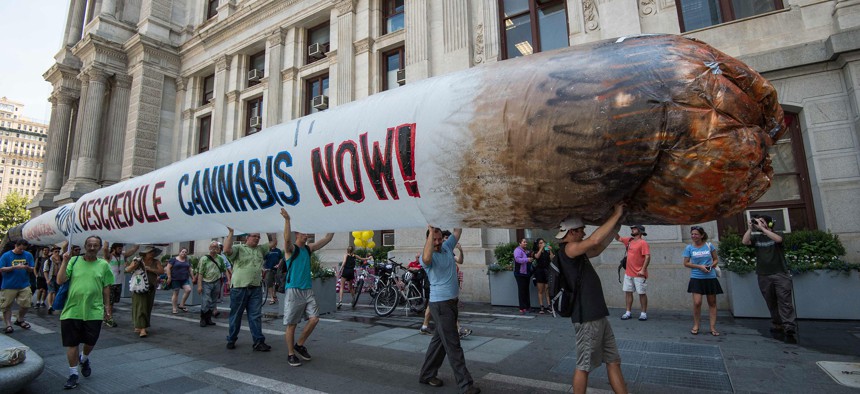
Marijuana advocates have long pushed for cannabis to be rescheduled – and legalized for recreational use – in Pennsylvania. NICHOLAS KAMM/AFP via Getty Images

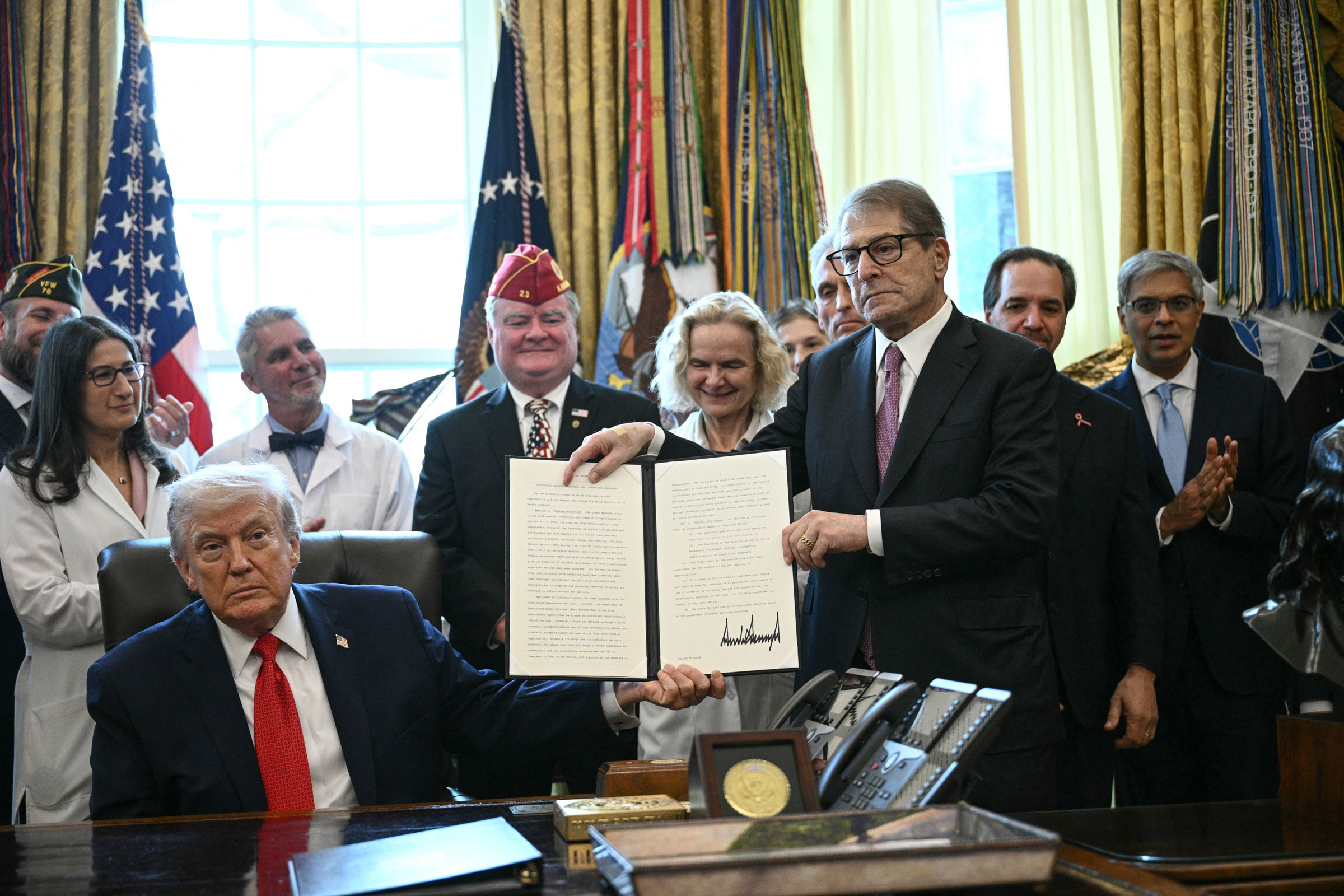
President Donald Trump’s administration took action in late April to reclassify cannabis for medical use from Schedule I to Schedule III, a move that could loosen restrictions on cannabis businesses and ultimately pave the way for broader federal policy changes on marijuana.
The decision comes at a time when Pennsylvania lawmakers continue to weigh whether to legalize cannabis for recreational use in the commonwealth, as many of the Keystone State’s neighbors have already done. To examine how the federal decision could impact Pennsylvania, City & State spoke with Democratic state Sen. Sharif Street, a leading sponsor of legislation to legalize recreational cannabis; Meredith Buettner Schneider, the executive director of the Pennsylvania Cannabis Coalition; and Dan Bartkowiak, the chief strategy officer at the Pennsylvania Family Institute.
The following conversations have been edited and condensed for length and clarity.
What are your thoughts on the federal government’s decision to move medical cannabis from Schedule I to Schedule III, and what that could mean for Pennsylvania?
Meredith Buettner Schneider: The movement of medical marijuana and FDA-approved marijuana products to Schedule III is the most significant federal reform we've seen at the federal level since they moved cannabis to Schedule I. So it's really, really exciting all around from a lot of perspectives. In states like Pennsylvania that have a regulated medical marijuana program, for that program to be recognized by the federal government in that way, hopefully, will lead to the modernization of the program. It certainly adds a layer of legitimacy to the program here in Pennsylvania that we did not have prior to the rescheduling.
Sharif Street: It is likely to be good, as it is being reclassified to create more access and fewer restrictions. It's hard for me to opine too deeply. I will say it's politically good, and it could create a permission structure for Republicans who already believe this should be legalized to move forward with the legalization of recreational adult use. That being said, it's hard to go beyond that, because this administration is unpredictable, and it's unclear what this means in terms of their enforcement. It's unclear how the banking community, for instance, will trust this as it relates to safe harbor provisions (language that protects banking and financial institutions from penalties) that existed under Biden and Obama. I need to see more.
I think they did this through executive order, which is the way they've chosen to do a lot of things, but it's created some irregularities. Is there a statement from the Justice Department committing to do nonprosecutions with respect to certain kinds of banking transactions that existed in previous administrations with respect to safe harbor? Is there a provision in it from the Justice Department that directs the FBI and interstate law enforcement not to enforce if there is transportation across state lines? If those directives exist, we'd have to look at how the banking and financial industry reacts to whatever language they put out, because that would have real-world implications for whether these transactions can truly take place across state lines.
Politically, I think it's a good thing. I think operationally, it's very much yet to be seen, in part, because when you have an administration that does things in an irregular way, and that is inconsistent in the way it does things in general, it becomes hard to predict what comes next in terms of their action. But the aforementioned notwithstanding, I have to say I'd rather him say it is descheduled, even through an executive order, rather than them saying something that is cannabis-punitive. Overall, it's good – with all those caveats.
Dan Bartkowiak: There are health concerns, there are safety concerns with regard to marijuana use that are often sometimes denied or not spoken of, so I think that needs to be part of this discussion. As it relates to rescheduling, yes, it's not legalizing for recreational use. I think there are implications for us. … First, there's abuse potential. I've talked with too many families that have seen the physical and psychological dependence of marijuana. A lot of times, it's been kids they've seen go through that, and sadly, how they've tried to pursue so many avenues to help them. I was just talking to a mom last week – she was using it for a medical purpose and just stopped because of the physical condition it was putting her in, and it was impacting relationships. There needs to be a recognition that that is happening: There's a variety of families in our state, around the nation, that are having significant issues with marijuana use and dependency. The more addictive use that we're seeing rising, I think that's a problem that we need to recognize.
I would suggest you don't have to reschedule to conduct research. You know, there are already thousands upon thousands of studies. There are a variety of researchers looking into what marijuana use is doing. A law was passed a few years ago to help make the process easier. I think there are certainly actions the Trump administration could have taken to ease those avenues of research … I can be in favor of any efforts to improve that process, but it shouldn't come at the cost of increasing avenues of abuse.
What impacts will this decision have on the existing medical cannabis landscape in Pennsylvania?
MBS: From a business perspective, the order does a couple of things. It removes the 280E tax burden, which was applied to medical cannabis simply because of its Schedule I status. That alone will have a huge financial impact on medical marijuana businesses and allow them to free up capital to improve products, potentially reduce prices for patients, invest in infrastructure, and invest in research. So from a business perspective, that is really exciting. The way the order is written, it encourages the Secretary of the Treasury to consider retrospective relief for 280E for all taxable years that businesses held a state medical license. Companies that have held licenses since 2017 here in the commonwealth could anticipate some retroactive tax relief that will allow for additional investment.
SS: In theory, a cannabis business, if it's rescheduled, you'd be able to claim certain deductions that you can't currently claim because you can't claim deductions associated with an illegal business – a drug dealer. Federal law previously treated cannabis the same way you treat a person dealing heroin. If I have a pickup truck that's otherwise eligible as equipment because I'm transporting my business materials in it, then I can deduct the payments on the truck as an operating expense. If it's paid off, I can take depreciation on the truck as a deduction, so I can claim both the depreciation and the truck's expense. Well, I can't do that if I'm transporting heroin. If cannabis is treated as a Schedule I drug, that's the same as heroin in the eyes of the law, and so you can’t take these deductions. If you're now saying it's rescheduled and the IRS respects this rescheduling in a way that indicates the traditional business deductions apply, there are a whole host of tax benefits that would apply to cannabis businesses.
DB: Marijuana itself is not a less dangerous drug. The high potencies and what we've done with commercialization have caused a variety of health harms. So the classification is changing, but the drug itself is still one that is causing more addiction, more mental health problems, and a variety of health harms.
When you look at the companies that are involved in commercialization, how rescheduling is going to influence them, a big part is that you've got tax breaks now. The marijuana industry is going to receive billions of dollars in tax breaks because of rescheduling to Schedule III. I don't think that's going to be keeping health and safety as a priority. I think it's an industry that wants to make more money off of the addictive use of their drug. So I think there are problems with that.
How might this decision to reschedule medical cannabis influence the conversation around legalizing cannabis for recreational use in Pennsylvania?
MBS: There's certainly been a sentiment that it was crucial for the federal government to act first before some caucuses of the legislature would continue the conversation about cannabis, particularly as it relates to adult-use cannabis. We have broad support across all four caucuses of the Pennsylvania legislature for our medical cannabis program. But I think that support is growing for the legalization and regulation of cannabis here in Pennsylvania. And as legislators see what's going on in markets in other states – border states of Pennsylvania – they're starting to get more curious, and I think that the rescheduling order breaks down some of the stigma around cannabis It allows folks to be more open to the conversation, because they do see some movement from the federal government.
It's important to note that while the initial order only moved state-licensed medical programs and FDA-approved products to Schedule III, there will be a hearing at the end of June to consider cannabis products outside of those medical frameworks. So, legalize recreational products. That hearing process will begin at the end of June. So the federal government is saying cannabis is medical. They're also saying, “We think it's time to start considering the broader scope of cannabis, the recreational side, the adult-use side of cannabis.” So I'm hopeful that will mean our folks here in Pennsylvania will also think it's time to more seriously consider those next steps. Any issue is hard to tackle with a divided government, particularly this issue. I think it's significant that this is a Republican president and a Republican administration moving forward with that. I hope that will break some of the log jams that we have, related to cannabis, with divided government here in Pennsylvania.

SS: I think that Democrats are largely very supportive of legalization. I think that the reticence, where it exists, is largely within Republican, more conservative circles. The Trump administration – a Republican administration – signaling that it believes it either is or should be rescheduled, depending on how you interpret what he did, certainly creates political cover for Republicans who may want to move forward. They can say, “Look, even the Trump administration is supportive of rescheduling.” So if you are a Pennsylvania state senator in a very red district … it makes it a lot easier for them to advance something that's commonsense legislation. From that perspective, it's very helpful politically, because he is signaling to the portion of the population that has been the most resistant that this is a good idea and important.
DB: I think more discussion is needed on the real implications of today's marijuana. It's not the Woodstock weed of the ‘70s and ‘80s. It's not single-digit THC. You have chemists who are getting supercharged potency marijuana products and advertising them with all kinds of fruity flavors. That needs to be recognized and discussed. When you have lawmakers that talk about it's not addictive, it's not dangerous … that's not today. I've talked with moms … with treatment facilities that have young men coming in addicted solely to marijuana. That used to never happen, and now it's kind of commonplace. So that needs to be more of the discussion.
When it comes to commercialization from a recreational standpoint, it's often, where are the dollars? That's what Gov. Shapiro is saying so often: we need the dollars; we want revenue. He doesn't talk about costs – the very real costs that will be incurred when you increase access to more addictive drugs. There are going to be healthcare costs, driving costs, workplace safety issues, and problems in education, but those are often not talked about. It's the marijuana industry being enriched at the expense of public health and safety. That's my concern with the recreational legalization debate.
What should the legislature's next step on cannabis policy look like?
MBS: First and foremost, the goal of the regulated industry here in Pennsylvania is to advance comprehensive adult-use legislation. That's what we wake up and focus on every day. There is also an element of not only divided government here, but of a very purple political state. We have been working on a piece of legislation that would take a first step toward a new way of regulating cannabis here in Pennsylvania: Senate Bill 49, sponsored by Sen. Laughlin. It moved out of the Law & Justice Committee, and we anticipate further consideration by the Senate when the legislature reconvenes in June. That bill would establish an independent regulatory body for all consumable cannabinoids; in essence, it would pull the medical marijuana program out from under the regulatory authority of the Department of Health and create this new agency to oversee medical marijuana. It would also give them the authority over the hemp intoxicants that are proliferating across the commonwealth; we've seen a lot of kids end up sick because of these products, because they're unregulated, they're untested. They fit into that federal Farm Bill loophole category, and they are causing a public health crisis here in Pennsylvania. So Senate Bill 49 would help the commonwealth get its arms around that problem, provide for enforcement resources to make sure that we can keep those products out of the hands of children – but it really also lays a foundation for what the legislature thinks the regulation of cannabis should look like going forward. An independent regulatory body solely focused on consumable cannabinoids, not working on other priorities, with the bandwidth to make sure that public health and safety related to the consumption of consumable cannabinoids is its focus. That's something we've been really supportive of.
SS: I still believe the comprehensive adult-use bill and the framework that Sen. Laughlin and I have advanced … is the right way to go, but there are elements of that that certainly could advance as a standalone bill. I would support the idea of a cannabis control board – it’s in the bill. We should advance the idea of dealing with incapacitation as a standard, versus the mere presence of metabolized cannabinoids in the system, which is just showing consumption. So being able to distinguish between consumption and incapacitation, and the timeliness of that consumption, is certainly an issue that's worthy of a standalone bill. Some of the criminal justice provisions around the expunging and sealing of everyone’s record having cannabis convictions are worthy of consideration. There are a number of things you could do as standalones. I think it's best that we get it done in a comprehensive bill.
DB: Certainly, there are actions that can and should be taken. I think the move that Congress did with the loophole in the Farm Bill – you have these intoxicating hemp products, the gas station weed that has really proliferated in so many communities – that certainly needs to be reined in. The state can certainly align with the federal language that would say intoxicating hemp products, that's not something we should see again in convenience stores, gas stations. The medical program – I don't think doctors should be looking at this just to make a lot of money. I think there needs to be actions to underscore more evidence-based decisions. Frankly, I question how we put anxiety disorder as something that is a qualifying condition. The decisions moving forward really should be rooted in medical evidence. So I think there can certainly be changes, even to our current medical program – even the high potencies that we see, I think there can be some discussion around that. From a recreational standpoint, you've got companies that are, frankly, going to profit. You've got Mike Tyson, who comes in because he thinks he can make more money off of these products. Those shouldn't be the voices that are driving policy, the ones that are going to profit from somebody who's addicted to this product. That's not what should drive the conversation.